
Quick transparency note: the diagrams were AI-generated to help illustrate the explanations more clearly. The technical analysis and wording are mine.
⚠️ Technical Note
This article is based on a technical analysis of BMW GS systems and a simplified educational interpretation of complex electronic riding dynamics.
The information provided is intended to improve overall understanding of how the motorcycle behaves under different riding modes.
It does not replace official BMW manufacturer data, service manuals, or repair procedures.
📌 Reading note
This article includes detailed technical diagrams designed to help explain BMW GS systems in a clear and structured way.
For the best reading experience, especially when reviewing technical diagrams, a desktop view is recommended.
The mobile version remains fully usable for general reading.
Understanding BMW GS Ride Modes in Real Conditions
BMW GS ride modes are among the most frequently used features in modern adventure motorcycles, yet also among the least understood.
Rain, Road, Dynamic, and Enduro modes are not simple performance presets.
They are part of a fully integrated electronic system that continuously adapts traction, braking, engine response, and overall motorcycle behavior in real time.
👉 The goal of this article is to make this system understandable in a clear, practical, and technically realistic way, without unnecessary complexity.
Introduction
BMW GS ride modes are used every day… but rarely fully understood.
Rain, Road, Dynamic, Enduro.
On paper, it looks simple.
In reality, it is a highly integrated electronic system that constantly changes how the motorcycle behaves depending on riding conditions.
The key point is simple:
ride modes do not change the bike
👉 they change how the bike supports and protects you in real time
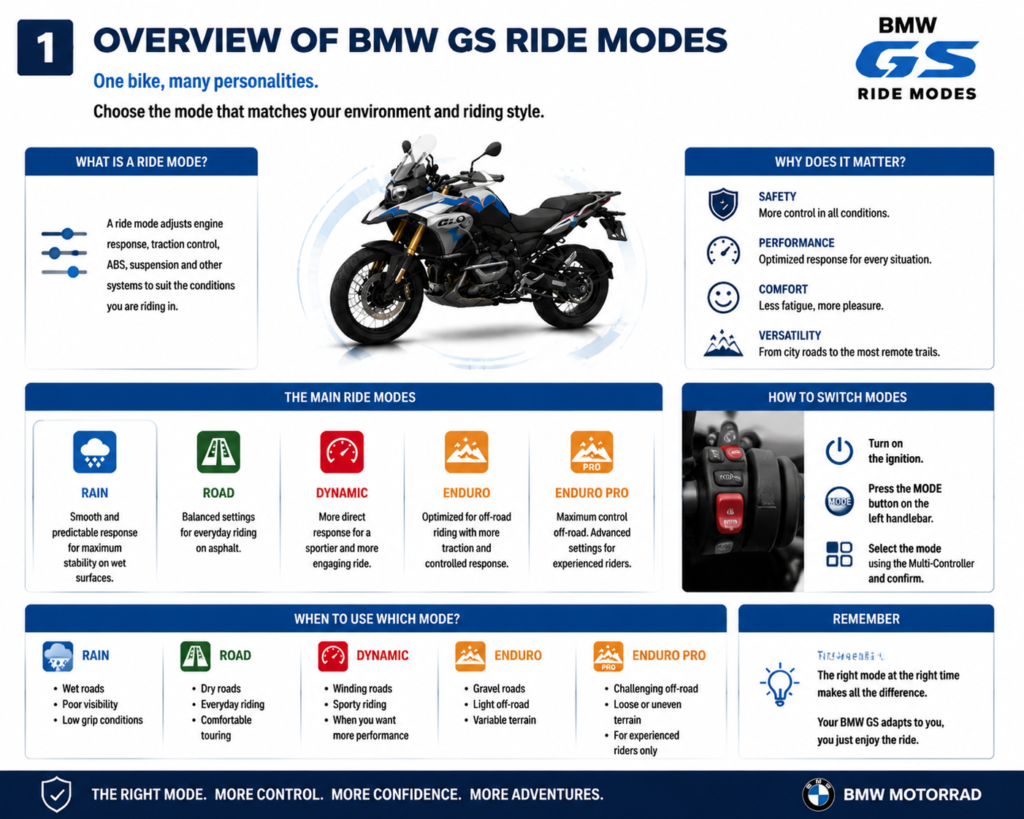
BMW GS ride modes diagram showing rider inputs, electronic systems, and motorcycle behavior output
1. A common misconception: ride modes change power
This is one of the most frequent misunderstandings.
In reality:
- engine power remains the same
- maximum output does not change
- there are no mechanical changes to the engine
👉 what actually changes is how power is delivered and controlled
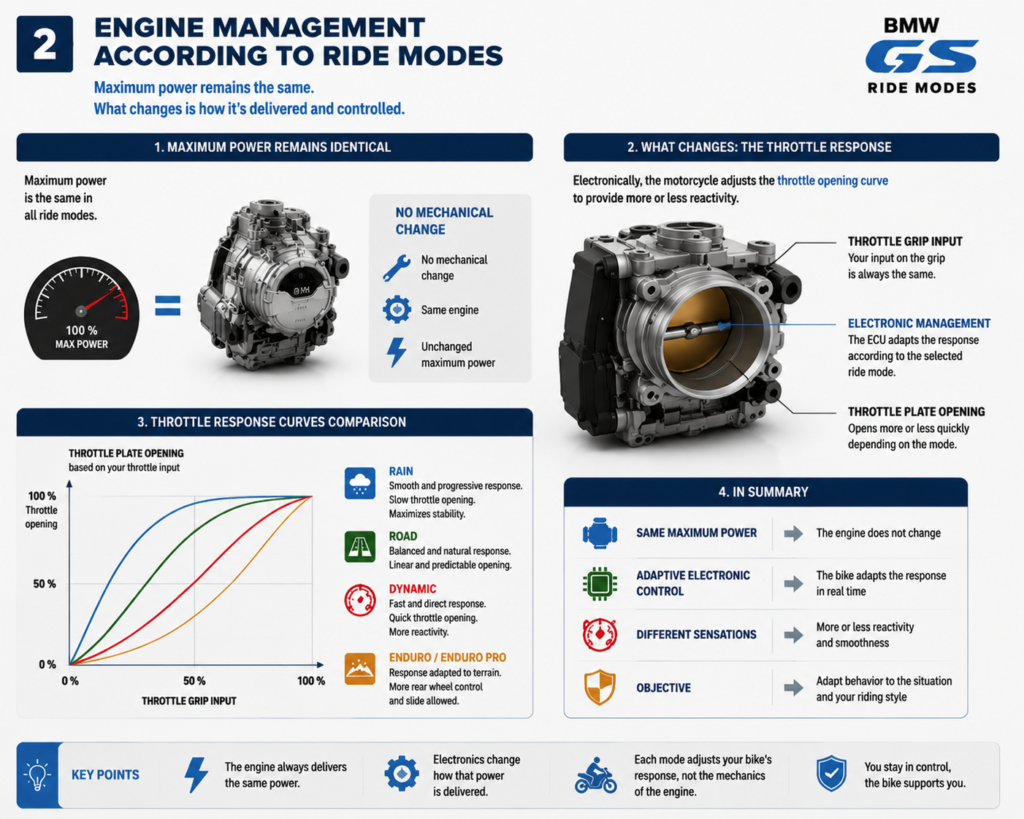
Illustration showing electronic throttle control adaptation based on BMW GS ride modes
2. What you actually feel on the bike
🟦 Rain Mode
- very smooth throttle response
- delayed and softened acceleration
- calm and filtered reactions
- progressive braking feel
👉 the bike intentionally reduces sharp inputs
Goal:
👉 maximum stability and safety on low grip surfaces
🟩 Road Mode
- balanced behavior
- natural throttle response
- minimal electronic intervention
👉 this is the standard GS setup for most conditions
🟥 Dynamic Mode
- sharper throttle response
- quicker engine reaction
- more lively feel
not more power
👉 just faster response and less filtering
🟨 Enduro / Enduro Pro
- increased wheel slip tolerance
- modified ABS behavior for loose terrain
- reduced traction control intervention
👉 the bike allows what road modes normally prevent
3. What is really working behind the scenes
Ride modes are not standalone maps.
They rely on a fully integrated system:
- ABS
- traction control (DTC)
- engine management
- wheel speed sensors
- IMU (inertial measurement unit)
👉 everything works together in real time
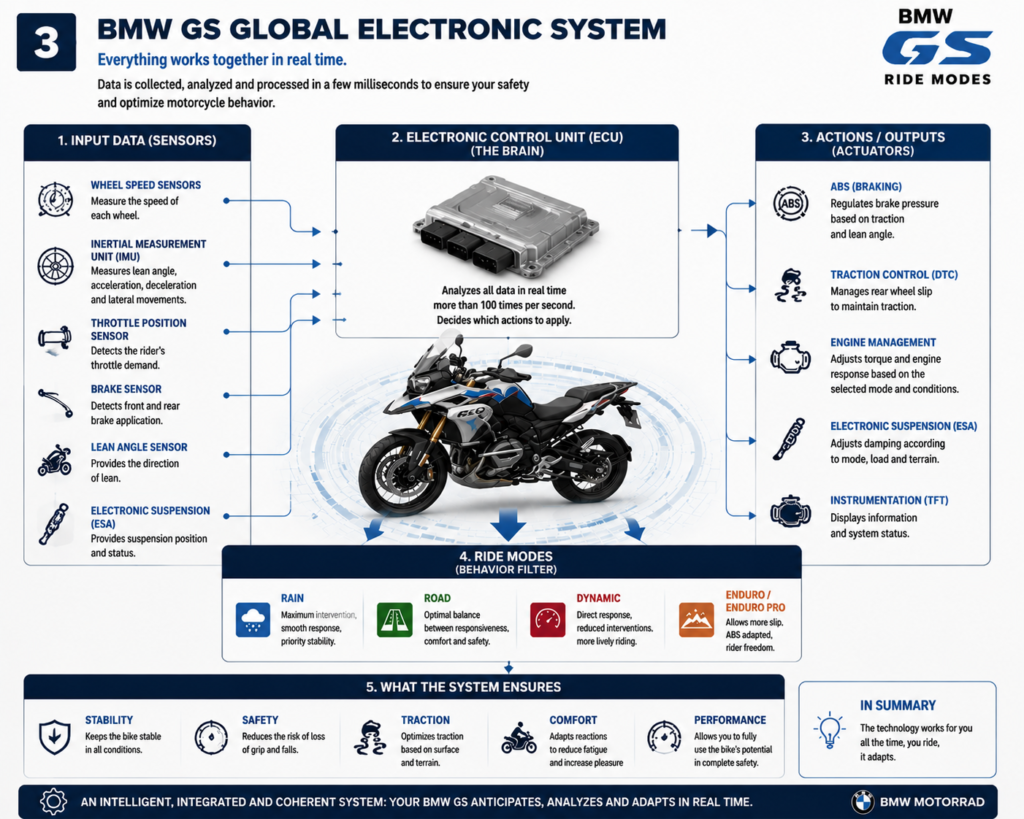
Diagram showing BMW GS data processing between rider inputs, IMU, ABS, traction control, and engine management
4. The IMU: the real brain of the system
The IMU continuously measures:
- lean angle
- acceleration
- deceleration
- lateral movement
And enables:
Cornering ABS
lean-angle sensitive traction control
real-time stability corrections
5. What BMW actually designed this system for
Ride modes are not designed for performance gains.
They are designed to:
👉 adapt the bike to grip conditions
👉 compensate for rider input errors
👉 maintain stability in all environments
6. The often forgotten link: ride modes and suspension
Ride modes only reach their full potential when combined with:
- electronic suspension (ESA / Dynamic ESA)
- bike load
- road surface type
Examples:
- Road + comfort suspension = smooth touring behavior
- Dynamic + firm suspension = sporty response
- Enduro + soft setup = better off-road control
👉 the GS is a fully integrated system, not separate settings
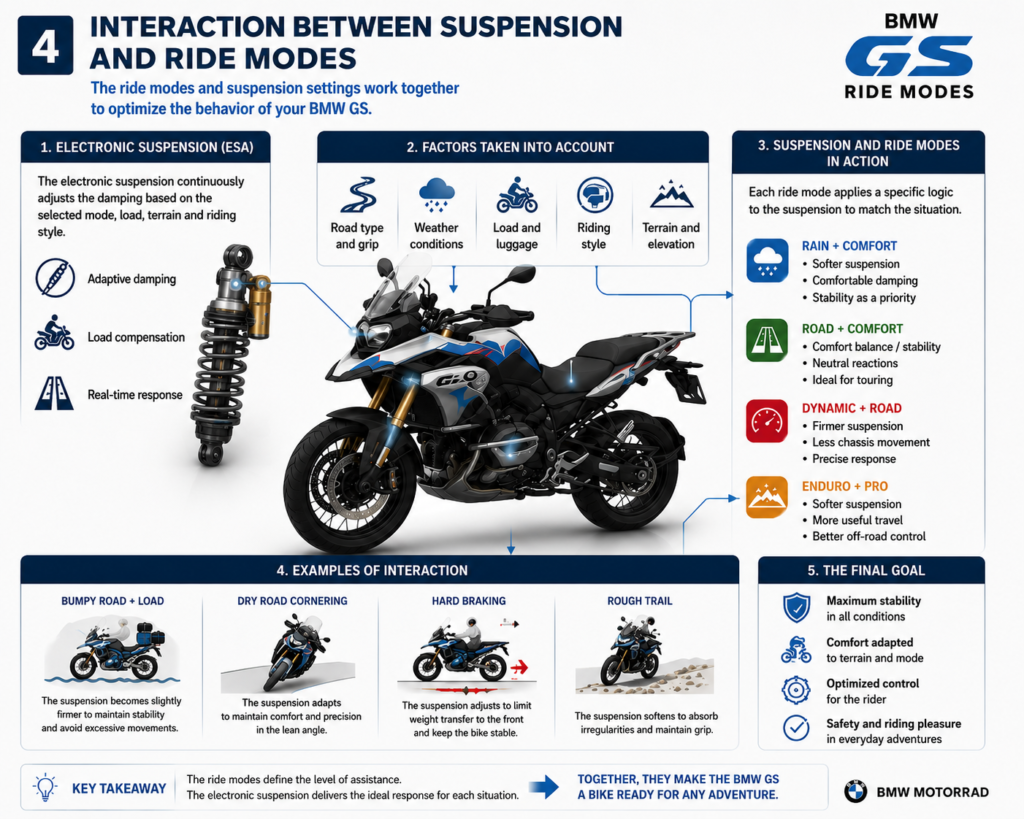
Diagram showing how BMW GS ride modes interact with electronic suspension settings and bike behavior
7. Most common mistakes (and why riders make them)
Most riders do not use ride modes incorrectly out of carelessness.
They do it for very human reasons.
1. Using Rain mode all the time
Rain mode feels safe.
So many riders:
- leave it on permanently
- even on dry roads
Why?
👉 it creates a constant feeling of protection
Problem:
- throttle feels dull
- bike loses natural flow
- reduced riding feedback
👉 safety is confused with smoothness
2. Misunderstanding Dynamic mode
Dynamic is often seen as:
a “performance mode”
So riders use it all the time thinking it is better.
Why?
mental association: sport = better
Problem:
- more sensitive throttle
- less electronic tolerance
- requires more precision
👉 on rough or wet roads it can feel too aggressive
3. Not adapting to real conditions
Many riders set one mode and never change it.
Why:
- habit
- simplicity
- lack of understanding
But the GS is designed to adapt to:
- weather
- grip level
- load
- riding style
👉 not changing modes means underusing the system
4. Sticking to a favorite mode
Why:
- comfort
- familiarity
- lack of system understanding
👉 there is no “best mode”
👉 only the right mode for the situation
Key takeaway:
Mistakes do not come from the system.
They come from how it is interpreted.
8. What really matters
Ride modes are not performance settings.
They are adaptive behavior systems.
They influence:
- throttle response
- electronic intervention levels
- overall bike behavior
Conclusion
A BMW GS does not change character depending on the mode.
it changes how much assistance and intervention it provides in real time
Once you understand this principle:
you stop selecting a mode for performance…
and start selecting it based on how much support you actually need from the bike
Final thought
Most riders think they are choosing a mode.
In reality:
👉 the bike is constantly adapting its behavior to maintain stability without the rider even noticing
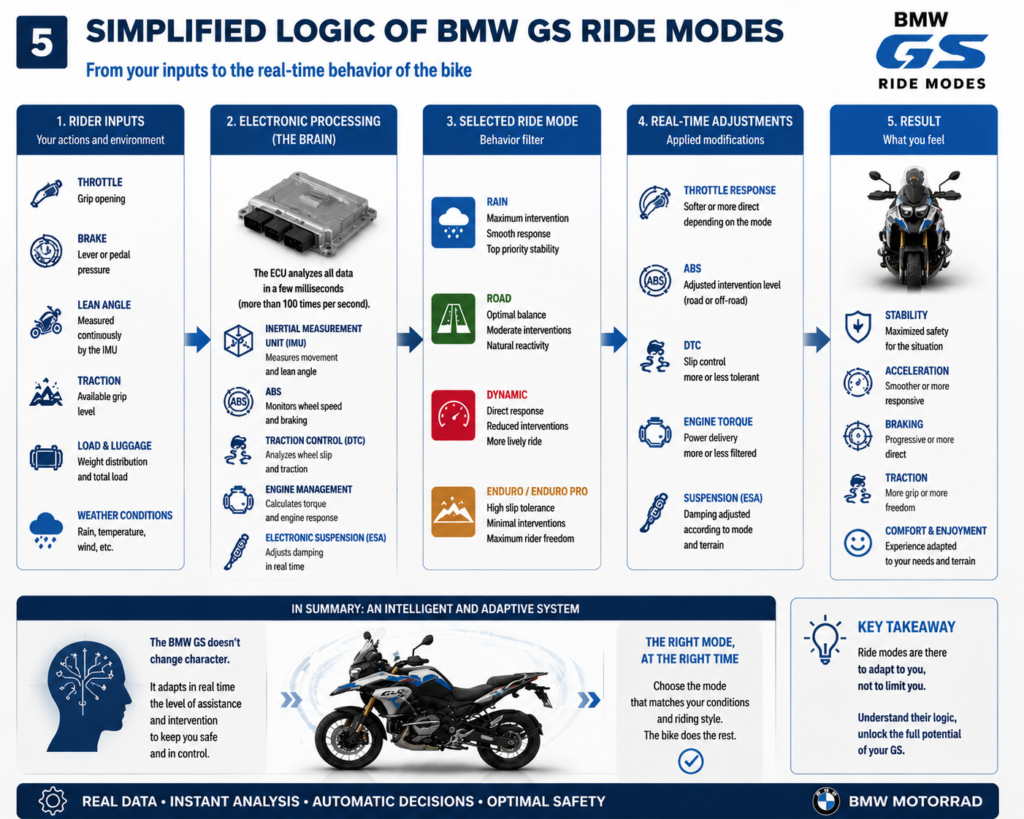
Simplified diagram showing rider input, electronic processing systems, ride modes filtering, and final motorcycle behavior output
Simplified logic model
Rider inputs:
- throttle
- brake
- lean angle
- grip level
↓
Systems:
- IMU
- ABS
- traction control
- engine torque management
- suspension
↓
Ride modes:
- Rain
- Road
- Dynamic
- Enduro
↓
Output:
- stability
- acceleration feel
- braking behavior
- traction control response
FAQ
Do BMW GS ride modes change engine power?
👉 No. The engine power output remains exactly the same. Ride modes only change throttle response and electronic intervention such as traction control and ABS behavior.
What is the best ride mode on a BMW GS?
👉 There is no “best” mode. Each mode is designed for specific conditions such as wet roads, dry pavement, sporty riding, or off-road situations. The correct mode depends entirely on riding conditions.
Does Dynamic mode make the bike faster?
👉 No. Dynamic mode does not increase horsepower. It only makes throttle response more direct and reduces electronic filtering for a sharper and more immediate feel.
Why does Rain mode feel so smooth and restricted?
👉 Rain mode increases electronic intervention to soften throttle response and limit sudden inputs, improving stability and safety on low-grip surfaces.
What does the IMU do on a BMW GS?
👉 The IMU (Inertial Measurement Unit) continuously measures lean angle, acceleration, deceleration, and lateral movement. It allows cornering ABS and lean-sensitive traction control to work in real time.
Can you ride a BMW GS in Road mode all the time?
👉 Yes. Road mode is the default balanced setting and works well in most conditions. However, it does not fully optimize the bike for extreme conditions like heavy rain or off-road riding.
Do ride modes replace rider skill?
👉 No. Ride modes assist the rider by improving stability and control, but they do not replace situational awareness or proper riding technique.
Chris Bach Workshop
This article is part of the “Chris Bach Workshop” series, focused on breaking down BMW GS and GS Adventure technical systems into clear, real-world explanations.
The goal of this series is to make modern motorcycle technology easier to understand for real riders, without oversimplifying the engineering behind it.