
On BMW GS/GSA LC models, driveshaft problems do not always begin with noise, vibration, or abnormal drivetrain behavior.
One of the most subtle issues is much simpler: moisture can remain trapped inside the driveshaft boot without the rider even realizing it.
At first, everything may seem perfectly normal. The bike runs properly, no warning lights come on, and there may be nothing to suggest that corrosion is beginning to develop in an area that is almost never visible.
That is precisely what makes this phenomenon important to understand.
The problem is not simply that a small amount of water can enter this area. The real risk appears when moisture remains there long enough to gradually promote corrosion on metal surfaces and splines.
And by the time the first symptoms become noticeable through the handlebars, the deterioration may already be much more advanced than the external condition of the boot would suggest.
In this article, we are going to look at why moisture can accumulate around the driveshaft, why it can remain hidden for a long time, which areas it can affect, and which signs should get your attention.
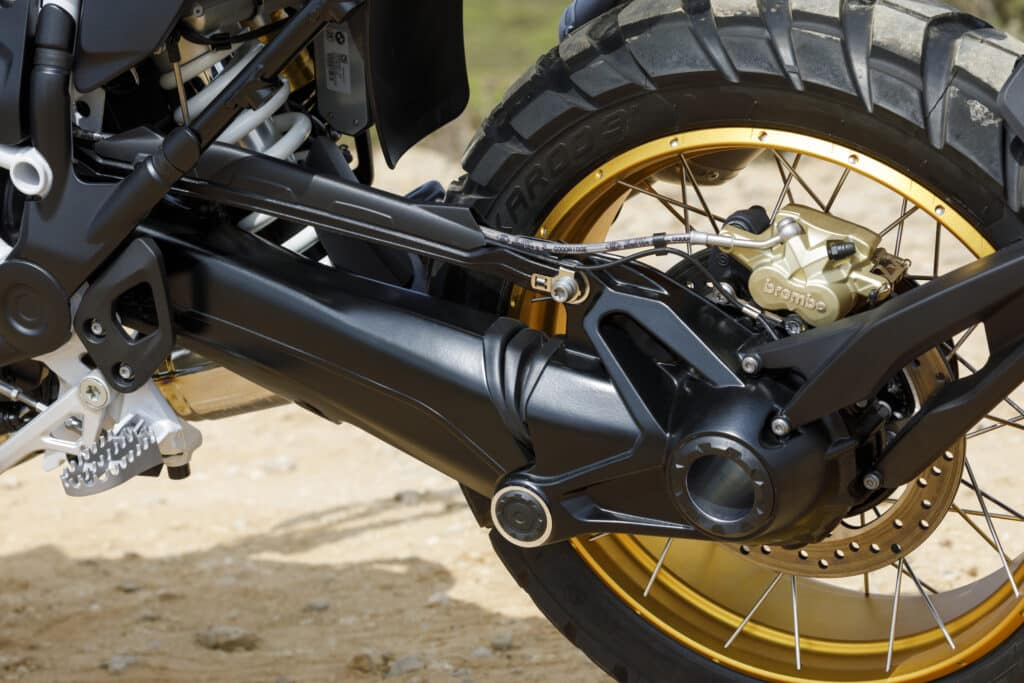
General view of the final drive assembly on a BMW GS/GSA LC. The driveshaft boot may appear perfectly sealed while moisture is already beginning to accumulate inside.
First, What Are We Talking About?
The driveshaft boot is the rubber component that protects the area between the final drive and the swingarm.
Its role appears simple: to limit the entry of water, dust, and debris around the metal components of the drivetrain.
It is an important form of protection, but one thing needs to be clearly understood: this area is not open to the outside air.
If moisture manages to get in, it can therefore remain trapped much longer than you might expect.
That is where the problem begins.
From the outside, the boot may appear perfectly seated and the motorcycle may operate normally. On the inside, however, even a small amount of moisture can gradually create an environment that promotes corrosion.
In other words, it is not only the visible condition of the boot that matters, but also what may be happening behind it without any obvious signs.
Why Can Moisture Accumulate Inside the Driveshaft Boot?
You might think that a properly installed boot would be enough to keep this area perfectly dry.
In reality, the conditions a BMW GS/GSA is exposed to are far more varied. Rain, wet roads, washing, mud, water crossings, temperature changes… over time, several factors can contribute to moisture being present around the drivetrain.
Temperature Changes Can Promote Condensation
While riding, the various mechanical components heat up. Once the motorcycle is stopped, they gradually cool down.
These temperature changes can promote condensation when humid air is present in this area.
A very small amount of water may seem insignificant. But when this process occurs repeatedly and the moisture cannot escape quickly, conditions gradually become more favorable for oxidation.
A Boot That Looks Fine Is Not Necessarily an Absolute Guarantee
This is one of the deceptive aspects of the problem.
A boot may appear properly positioned during a simple visual inspection without that being enough to confirm that the area has remained perfectly dry throughout the life of the motorcycle.
A slightly displaced lip, debris on a sealing surface, or imperfect positioning after maintenance work can affect the protection of the area without immediately creating an obvious external issue.
The absence of visible signs around the boot is therefore not enough, on its own, to prove that there is no moisture inside.
The Drivetrain Is Constantly Exposed to Spray
The position of the driveshaft at the rear of the motorcycle naturally exposes it to spray from the wheel and the road.
Rain, wet roads, mud, salt, or repeated washing all increase the opportunities for this area to be exposed to water.
That obviously does not mean that riding in the rain once will cause a driveshaft problem.
It is repeated exposure combined with moisture that remains trapped that is most important to understand.
Trapped Moisture Dries Much More Slowly
This is ultimately what makes this area different from a metal surface that is directly exposed to the air.
On an external part of the motorcycle, water can generally drain away and then evaporate.
Inside an area protected by a boot, conditions are different. If moisture is present, it can take much longer to escape.
And that is when the duration of exposure becomes important.
A small amount of moisture that is present only temporarily and moisture that remains for a long period of time do not create the same conditions for metal surfaces.
What Moisture Can Actually Damage
A small amount of moisture obviously will not destroy a driveshaft overnight.
The main problem comes from repeated or prolonged exposure of metal surfaces that work together and are normally protected against corrosion and wear.
Over time, several phenomena can then combine.
The Splines Are Particularly Important
The splines provide the mechanical connection between the various drivetrain components and transmit engine torque.
Their surfaces therefore operate under load and with very small relative movements.
When moisture remains in this area, corrosion can gradually alter the condition of the contact surfaces.
This is not necessarily dramatic at first.
Small traces of oxidation may appear before any change becomes noticeable through the handlebars. If these conditions persist, corrosion and micro-movements can then contribute to the gradual deterioration of the surfaces in contact.
This is one of the situations in which fretting can occur, a form of localized wear caused by very small repeated movements between two contacting surfaces.
The Presence of Water Can Compromise Surface Protection
The lubrication and protection applied to contact areas are specifically intended to limit friction, wear, and direct exposure of the metal.
When water or contaminants remain in this area, operating conditions are no longer as favorable.
The issue is therefore not simply whether grease can be seen around a spline.
What matters is the actual condition of the surfaces it is intended to protect and the environment in which those surfaces have been operating.
Corrosion Can Progress Without Being Visible
This is probably the most deceptive aspect.
The affected surfaces are located behind the boot and cannot be seen during a simple walk-around inspection of the motorcycle.
Corrosion can therefore begin and progress while everything on the outside appears perfectly normal.
During this time, the drivetrain may also continue to operate without enough noise or vibration to attract the rider’s attention.
The Driveshaft Joints Are Another Critical Area
The driveshaft is not just a set of splines.
Its joints are constantly working as the suspension moves and engine torque is transmitted.
Mechanical deterioration in this area is different in nature from simple surface corrosion on the splines and should not be confused with it.
This is also why the absence of visible rust in one area alone is not enough to draw a conclusion about the overall condition of the driveshaft.
The Real Problem Is How It Develops Over Time
This is ultimately the key point.
Finding a trace of moisture once does not mean that the drivetrain is doomed.
However, persistent moisture combined with corrosion and mechanical surfaces operating under load can gradually turn a subtle issue into a genuine mechanical problem.
It is this silent progression, far more than the presence of a single drop of water, that makes it important to understand and monitor this area.
Why Can This Problem Remain Hidden for So Long?
This is one of the most deceptive aspects of moisture-related deterioration in the drivetrain.
On a BMW GS/GSA LC, no electronic system directly monitors the condition of the splines or the presence of moisture inside the driveshaft boot.
There is therefore no specific warning light that comes on simply because corrosion is beginning to develop in this area.
And above all, early-stage deterioration does not necessarily cause any noticeable change in the motorcycle’s behavior.
Unlike other faults that can be detected through an electronic scan (see my MotoScan Diagnostic Guide), driveshaft corrosion remains invisible to the motorcycle’s electronics; only a physical inspection can reveal it.
The Drivetrain Can Continue to Operate Normally
The first signs of corrosion may affect only certain surfaces without immediately preventing torque transmission.
The rider can therefore continue riding without noticing any new noise, unusual vibration, or abnormal sensation.
This is precisely what can create a false sense of security:
“I don’t feel anything, so everything must be fine.”
In mechanical terms, and especially in a hidden area like this one, that reasoning has its limits.
The absence of symptoms simply means that no noticeable symptoms have appeared. By itself, it does not reveal the condition of the surfaces located behind the boot.
Noticeable Symptoms May Appear Late
For internal deterioration to begin affecting what the rider feels, it generally has to progress far enough to influence the mechanical operation of the drivetrain.
That is when new vibrations, an unusual sensation, or certain noises that were not present before may eventually appear.
At that point, it is no longer the same situation as simple preventive detection.
Waiting for a driveshaft to begin showing clear signs of a problem therefore means waiting for exactly what preventive maintenance is intended to avoid.
That Is the Whole Point of Preventive Monitoring
The goal is not to treat every trace of moisture as a sign of impending failure.
It is to understand that a hidden mechanical area can deteriorate without immediately sending an obvious warning to the rider.
That is why the motorcycle’s usage history, its exposure to water and moisture, the external condition of the boot, and the possible appearance of unusual signs all become meaningful when considered together.
Monitoring this area therefore helps ensure that you are not relying solely on the late appearance of a symptom before starting to pay attention to the condition of the driveshaft.
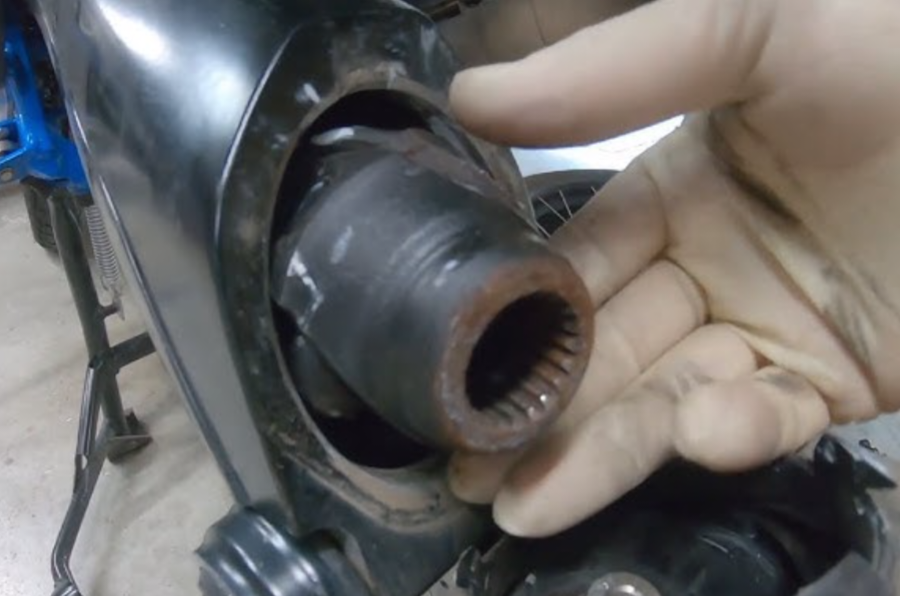
Periodic inspection of the splines remains the most reliable way to detect the early stages of corrosion before it can cause lasting damage to the drivetrain.
Fortunately, even though moisture often remains hidden at first, certain signs can gradually appear and should get your attention before the damage becomes significant.
What Signs Should Get Your Attention?
One of the traps would be to treat every noise or vibration coming from the rear of the motorcycle as proof of a driveshaft problem.
That would be jumping to conclusions far too quickly.
A vibration, play, or noise can have several possible causes. However, the appearance of something new or the gradual change of a familiar sensation should always be taken seriously.
Certain signs may justify taking a closer look at the condition of the drivetrain.
An Unusual Sensation When Turning the Rear Wheel
If the wheel no longer seems to rotate as smoothly as before, with a feeling of resistance or less fluid movement, it may draw attention to different components of the rear drivetrain.
That does not mean the driveshaft is necessarily responsible.
What matters most is the appearance of a new sensation compared with the motorcycle’s normal behavior.
New Vibrations While Riding
A vibration that was not present before also deserves attention.
It may be felt under load, when getting back on the throttle, or under certain specific riding conditions.
But once again, vibration is not unique to a driveshaft problem. Tires, wheels, bearings, or other mechanical components can sometimes produce very similar sensations.
A change from the motorcycle’s normal behavior is therefore more meaningful than the vibration by itself.
A Drivetrain Noise That Changes Over Time
Driveshaft systems naturally have a certain amount of mechanical play and can produce completely normal noises during changes in load.
What deserves more attention is the appearance of a new noise or a “clunk” whose intensity or frequency gradually changes.
The goal is not to treat every noise as a failure, but rather not to automatically dismiss a behavior that has recently changed.
Signs of Moisture or Corrosion Around the Boot
This is obviously one of the signs most directly related to the subject of this article.
Repeated signs of moisture, brownish discoloration, unusual deposits, or indications of corrosion around this area do not tell you exactly what is happening behind the boot.
They do, however, provide a good reason not to rely solely on its external appearance.
Changes After Maintenance or Over Time
It is also useful to consider the motorcycle’s history.
If a drivetrain that previously seemed to operate normally gradually develops a new sensation after several months or several thousand miles, that change provides more useful information than a single isolated sensation noticed only once.
This is especially true when several signs appear together.
One Sign Alone Is Not Enough to Make a Diagnosis
This is probably the most important point in this section.
None of the signs above, by itself, is enough to confirm that the driveshaft is damaged.
They should be treated as reasons for closer attention, not as a mechanical verdict.
The value of a preventive approach is precisely to identify an unusual change early enough to determine its cause properly, rather than waiting until a symptom becomes obvious.
Which Motorcycles Are Most Exposed?
Not all BMW GS/GSA LC models are obviously used under the same conditions.
Two motorcycles showing exactly the same mileage can have experienced very different environments. Mileage alone therefore does not provide a complete picture of how much the driveshaft has been exposed to moisture.
The frequency of contact with water, storage conditions, type of use, and even certain washing habits can also play a role.
Motorcycles Used Year-Round
A GS/GSA used every day goes through more riding, heating, and cooling cycles, but also has more opportunities to be ridden in the rain or on wet roads.
Regular use of the motorcycle is not a problem in itself.
It simply means that repeated exposure to moisture increases the opportunities for this area to come into contact with water and contaminants.
Humid or Salty Environments
Coastal areas, very humid regions, or roads treated with salt are particularly aggressive environments for metal surfaces.
Salt deserves particular attention because it can accelerate corrosion when combined with moisture.
A properly maintained motorcycle can obviously be used under these conditions. But its environment should be part of the overall assessment when considering the value of preventive monitoring.
Off-Road Use
Off-road riding exposes the rear of the motorcycle more heavily to water, mud, sand, and dust.
A GS/GSA that is regularly ridden off pavement can therefore experience very different conditions from a motorcycle used mainly on dry roads.
Once again, off-road use does not automatically mean a driveshaft problem.
It is simply an additional exposure factor to take into account when considering the motorcycle’s actual history.
Frequent or Aggressive Washing
A very clean motorcycle is not necessarily a motorcycle that has been less exposed to moisture.
Frequent washing also increases contact with water, particularly when the spray is repeatedly directed toward areas protected by boots or seals.
The question is therefore not simply how often the motorcycle is washed, but under what conditions certain mechanical areas are exposed to water during cleaning.
What About Motorcycles That Are Rarely Ridden?
This is a case that is easy to overlook.
A low-mileage motorcycle is not automatically protected against corrosion.
If moisture is already present in a confined area, a long period of storage does not guarantee that it will disappear quickly.
That is why age, mileage, and the actual condition of a drivetrain do not always tell exactly the same story.
Usage History Matters as Much as the Odometer
That is ultimately the key takeaway.
There is no single type of BMW GS/GSA that will necessarily develop driveshaft corrosion.
However, knowing the conditions in which the motorcycle has been ridden, washed, and stored provides a better understanding of its level of exposure.
Two motorcycles with 18,600 miles (30,000 km) can have had very different mechanical lives.
Why a Simple External Inspection Is Not Always Enough
This is probably one of the most important limitations to understand when talking about the driveshaft boot.
A visual external inspection is useful. It can reveal a displaced boot, signs of moisture, grease splatter, or an obvious abnormality.
But it does not allow you to directly see the condition of the splines and metal surfaces located behind the boot.
That is the whole difficulty.
A Clean Boot Does Not Necessarily Mean Everything Behind It Is Perfect
When no signs of water, grease, or corrosion are visible on the outside, it is naturally tempting to assume that the area is in good condition.
But the outside of the boot tells only part of the story.
If moisture was present previously, the first signs of oxidation may develop in an area that remains completely invisible during an external inspection.
That is why the appearance of the boot is an indicator, not a diagnosis of the internal condition of the drivetrain.
Mileage Does Not Tell the Whole Story Either
It can also be tempting to judge the situation based only on the odometer.
A low-mileage motorcycle may have been exposed to a lot of rain, frequent washing, or long periods of storage in a humid environment.
Conversely, a motorcycle with higher mileage that has been ridden under favorable conditions may present a very different situation.
The condition of the driveshaft therefore depends on several factors that cannot be reduced to a single number.
Symptoms Sometimes Appear After Deterioration Has Already Begun
As we saw earlier, early-stage corrosion does not necessarily cause noise or vibration right away.
This creates a particular situation:
the outside may look normal, the rider may feel nothing unusual, and yet some hidden surfaces may already have begun to deteriorate.
It is precisely this gap between what you can see, what you can feel, and what may actually be happening behind the boot that makes preventive maintenance so valuable.
Prevent Rather Than Wait for Mechanical Confirmation
The goal is not to open up the drivetrain at the slightest doubt or to assume that every GS/GSA has a problem.
It is simply to understand the limitations of relying only on an external inspection.
When you know the motorcycle’s environment, how it has been used, and which signs deserve attention, you are in a much better position to judge the value of a proper preventive inspection.
Waiting for noise, vibration, or mechanical play to confirm that a problem exists means losing part of the advantage of prevention.
Why Is Preventive Driveshaft Maintenance Important?
At this point, it becomes easier to understand why the driveshaft presents a particular issue: a significant part of what can deteriorate remains hidden, and the early stages of corrosion can progress without immediately causing any noticeable symptoms.
That is precisely what makes preventive maintenance so important.
The goal is not to take action because the driveshaft has already failed.
It is to be able to assess its condition before there is an obvious mechanical reason to do so.
Protect the Surfaces That Transmit Torque
The splines are not simply metal surfaces located behind a boot.
They are directly involved in transmitting engine torque and operate under load during every acceleration and deceleration.
Their surface condition therefore has real mechanical importance.
When corrosion and wear begin to alter these surfaces, the issue is no longer simply about the appearance of a component: it directly affects an essential mechanical connection within the drivetrain.
That is why preventing their deterioration is far more valuable than discovering too late that they have already been seriously affected.
Identify Changes Before They Become Noticeable Through the Handlebars
Preventive maintenance also completely changes the way the area is monitored.
Instead of waiting for:
- a new noise;
- a vibration;
- unusual play;
- or a change in drivetrain behavior,
the goal is to understand the condition of the area before these symptoms appear.
That is the difference between monitoring a mechanical system and waiting for it to tell you that a problem already exists.
Preserve the Reliability of the Entire Drivetrain
The driveshaft operates as part of a complete system.
The driveshaft itself, its joints, the splines, and the final drive all work together to transmit engine torque to the rear wheel.
A deterioration that progresses for long enough can therefore eventually involve much more than a small area of superficial corrosion.
The earlier a problem is identified, the greater the chance of preventing localized deterioration from developing into a much more serious mechanical issue.
Prevent a Small Problem From Becoming an Expensive Repair
This is also where prevention makes sense financially.
A trace of moisture or the beginning of corrosion and a drivetrain showing advanced mechanical wear are obviously not the same situation.
When deterioration progresses far enough, the affected components can become much more expensive to repair or replace.
The principle is simple:
on a drivetrain, something that is subtle and inexpensive to monitor today can become far more complicated to deal with if you wait until symptoms appear.
The Goal Is Not to Worry, but to Understand
Talking about moisture and corrosion inside a driveshaft does not mean that every BMW GS/GSA LC is destined to develop this problem.
That would be the exact opposite of the purpose of this article.
The idea is simply to understand why this area deserves preventive attention, particularly when the motorcycle’s operating conditions increase its exposure to moisture.
Once this logic is understood, driveshaft maintenance is no longer something you do simply “because it has to be done.”
It becomes an inspection whose mechanical purpose and value you truly understand.
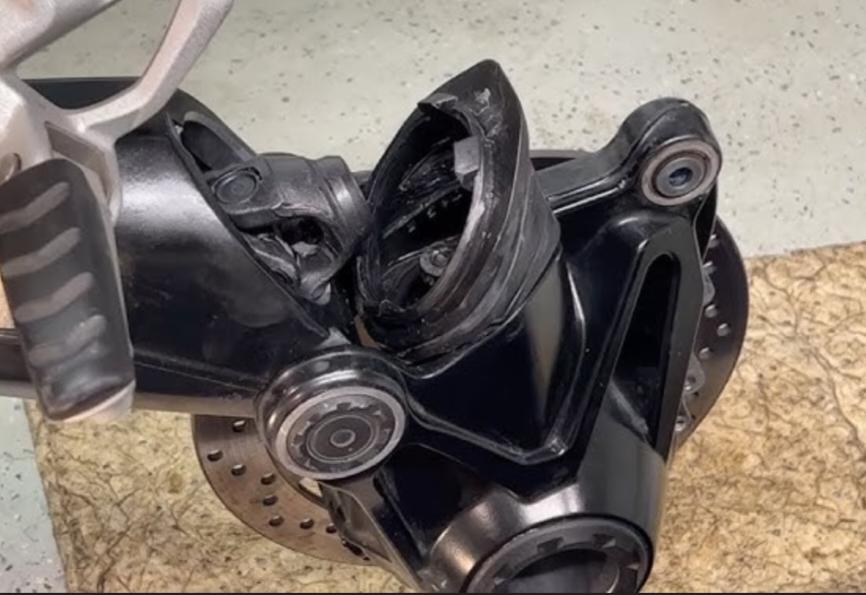
Periodic driveshaft maintenance allows the areas most exposed to moisture and corrosion to be inspected before the first signs of wear become noticeable while riding.
Key Takeaways
Moisture inside the driveshaft boot is a good example of a mechanical issue that can develop for a long time without attracting the rider’s attention.
The boot may appear perfectly seated. The motorcycle may ride normally. No warning light comes on, and there may be no particular noise to indicate that corrosion is beginning to develop on hidden drivetrain surfaces.
That is precisely why the absence of symptoms should not be confused with certainty that everything inside is in perfect condition.
Mileage does not tell the whole story either. Riding conditions, repeated exposure to water, washing, the environment, and periods of storage can all influence what happens behind the boot.
The goal is not to worry every time you notice a trace of moisture.
It is to understand why this area deserves preventive attention before a subtle issue develops into much more serious mechanical deterioration.
And that is ultimately the whole logic of preventive maintenance: do not wait for the motorcycle to show a problem before paying attention to what can help prevent it.
Going Further
Understanding why moisture can become a problem is the first step.
But when it comes to actually inspecting the driveshaft, assessing the condition of the splines, properly cleaning the area, protecting the surfaces, and then reassembling everything correctly, the method becomes just as important as the diagnosis itself.
That is precisely the part I reserve for the guide.
In it, I detail the complete driveshaft inspection, the points to check, the areas of corrosion to watch for, cleaning and protection methods, torque specifications, common mistakes to avoid, and the entire step-by-step procedure with photos and workshop logic.
The blog helps you understand why this area deserves your attention.
The guide shows you how to do the job correctly and without improvising.
Related Quick Check:
This Quick Check complements the article by highlighting the early warning signs to look for before taking the next step.
Full Maintenance Guide:
https://chrisbach.gumroad.com/l/iagmmp
The blog helps you understand.
The guide helps you take action correctly, step by step.
Join the Facebook group:
https://www.facebook.com/groups/913934631041780
Back to the blog:
https://chrisbachworkshop.com/blog/