
On a BMW GS/GSA LC, BMW GS LC cooling problems do not necessarily begin with a sudden rise in temperature or a red warning light on the dashboard.
Very often, the first signs are much more subtle: a slight coolant smell after a ride, a whitish deposit around a connection, a small damp area, or a coolant level that gradually drops without any obvious leak on the ground.
And that is exactly what makes these problems easy to underestimate.
As long as the motorcycle runs normally, starts well, and the temperature appears stable, it is tempting to dismiss these small signs as unimportant.
Yet the cooling system operates within a precise balance of temperature, pressure, coolant circulation, and the system’s ability to remove the heat produced by the engine.
A small coolant loss or the beginning of a sealing issue therefore does not necessarily cause an immediate failure.
It can develop slowly, sometimes over several weeks, before the motorcycle’s thermal behavior actually begins to change.
That is why a problem detected early is very different from the same problem discovered only after a genuine overheating event.
In this article, we will look at why the cooling system is essential on BMW GS/GSA LC models, why some leaks develop very slowly, which signs can appear before a failure, and why the trend over time is often more important than a single observation.
Why Is the Cooling System So Important?
On BMW GS/GSA LC engines, the cooling system does not simply prevent the engine from “getting too hot.”
It directly helps maintain an operating temperature compatible with lubrication, mechanical clearances, sealing, and overall engine reliability.
The engine naturally produces a great deal of heat. The role of the cooling system is therefore to keep that temperature within a controlled range, regardless of operating conditions.
Temperature Directly Affects Engine Operation
As an engine heats up, its various components expand.
Mechanical clearances, oil properties, and the operating conditions of seals therefore change with temperature.
The cooling system helps limit these variations and keeps the engine within the conditions intended for normal operation.
Cooling is therefore not simply a matter of thermal comfort: it directly contributes to the engine’s mechanical balance.
Overheating Does Not Always Cause Immediately Visible Damage
Severe overheating can obviously cause damage very quickly.
But not all consequences are necessarily immediate.
Excessive heat exposure can also accelerate the aging of certain seals, alter lubricant properties, or increase the thermal stress placed on various components.
The engine may therefore continue to run after an abnormal temperature event without that proving that no consequences occurred.
That is also why prevention is more valuable than waiting for an obvious symptom.
A Small Coolant Loss Can Gradually Change the Balance of the System
A slow leak can seem relatively unimportant as long as the motorcycle continues to run normally.
But what matters is not only the amount of coolant lost at a given moment.
If the level drops far enough, coolant circulation within the system can be affected and air can become trapped in certain areas.
Air does not transfer heat the same way coolant does.
Areas that are not properly supplied with coolant may then dissipate heat less effectively and develop higher local temperatures.
That is why a very slow leak can remain unnoticed for a long time before eventually changing the engine’s thermal behavior.
The Problem Is Not Just the Temperature Display
A cooling system can begin to change without immediately causing an abnormal indication on the dashboard.
A small drop in coolant level, slight seepage, or an early sealing issue can appear long before actual overheating occurs.
That is precisely why the first visible signs around the system can be more useful than waiting for a temperature warning.
Why Do Cooling System Problems Often Develop Slowly?
Cooling system problems do not always begin with an obvious leak or immediate overheating.
Very often, they develop gradually.
That slow progression is what makes them easy to underestimate: as long as the motorcycle runs normally and the displayed temperature does not appear abnormal, a small seepage or slight drop in coolant level can seem insignificant.
Heat and Pressure Cycles Repeat on Every Ride
Each time the motorcycle is used, the engine heats up and the cooling system is subjected to pressure changes.
Once the motorcycle is stopped, the system cools down and gradually returns to its resting state.
These cycles repeat hundreds of times over the course of many miles.
Over time, they place repeated stress on hoses, connections, seals, and the various sealing points throughout the system.
That does not mean a component will necessarily begin to leak.
But a loss of sealing can develop gradually, without a sudden failure or dramatic warning sign at first.
Dried Coolant Traces Can Be More Important Than They Look
A very small leak does not always leave a drop on the ground.
Coolant may simply seep out in a very small amount, then dry on a hot surface or over time.
This can leave a mark, deposit, or unusual discoloration around a connection, hose, or sealing area.
That is exactly what makes these signs useful.
A dried trace can be evidence of something that is no longer visible at the moment you inspect the motorcycle.
The mistake would be to automatically assume there is no problem simply because the area is dry when you look at it.
The Cooling System Often Leaves Clues Before a Failure
That is probably the good news.
A cooling system problem does not always appear suddenly.
Before a major leak or overheating event, the system may sometimes show much more subtle signs:
- a whitish deposit;
- a slight coolant smell;
- a damp area;
- a gradual change in coolant level;
- a change in the motorcycle’s thermal behavior.
Taken individually, these signs do not necessarily allow you to make a diagnosis.
But they can draw attention early enough to avoid waiting until a subtle problem becomes an obvious failure.
Which Areas of the Cooling System Deserve Particular Attention?
Not all coolant losses show up in the same way.
Some areas may first show a simple deposit, a damp trace, or a gradual change in coolant level, long before an obvious leak becomes visible.
The goal is not to treat every mark as a failure.
It is to understand which areas can show early warning signs and why those signs are worth monitoring.
The Water Pump Area
The water pump is one of the areas where a sealing issue can begin very subtly.
At first, you may simply notice:
- a slight coolant smell after a ride;
- a damp trace;
- a whitish or colored deposit around the area.
A small trace alone is not enough to conclude that the pump is faulty.
But it may show that coolant has been present in an area where it would not normally be expected to appear externally.
What becomes particularly useful is whether the sign repeats or changes over time.
Hoses and Their Connections
Hoses, fittings, and the various connection points are subjected to changes in temperature and pressure within the cooling system.
An area may appear perfectly dry when the motorcycle is cold, then show slight seepage only when the engine is hot and the system is under pressure.
That is why dried deposits around a connection can sometimes tell you more than the condition of the area at the exact moment you inspect it..
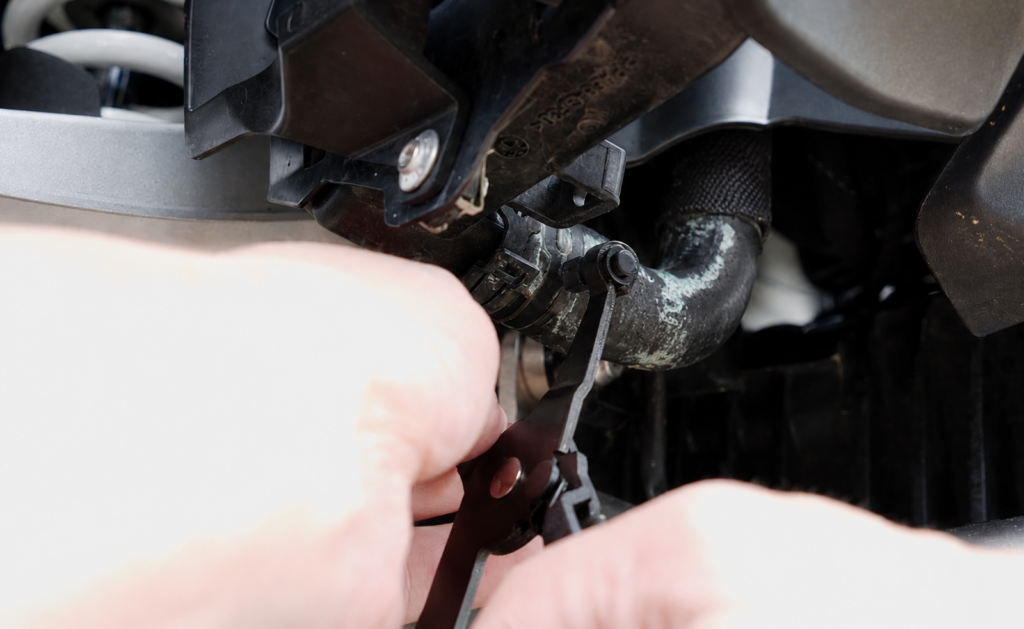
Whitish deposits around a hose or connection can be evidence of a previous coolant seep. Even when the area is dry at the time of inspection, these traces should be considered in the context of how the cooling system has changed over time.
The Radiator and Radiator Cap Area
The radiator does more than simply remove heat.
The cooling system also depends on its ability to maintain the intended pressure conditions.
A trace around the cap, a damp area, or an unusual deposit can therefore draw attention to this part of the system.
That does not automatically mean the cap or radiator is faulty.
But a loss of sealing in this area can affect cooling system operation long before actual overheating occurs.
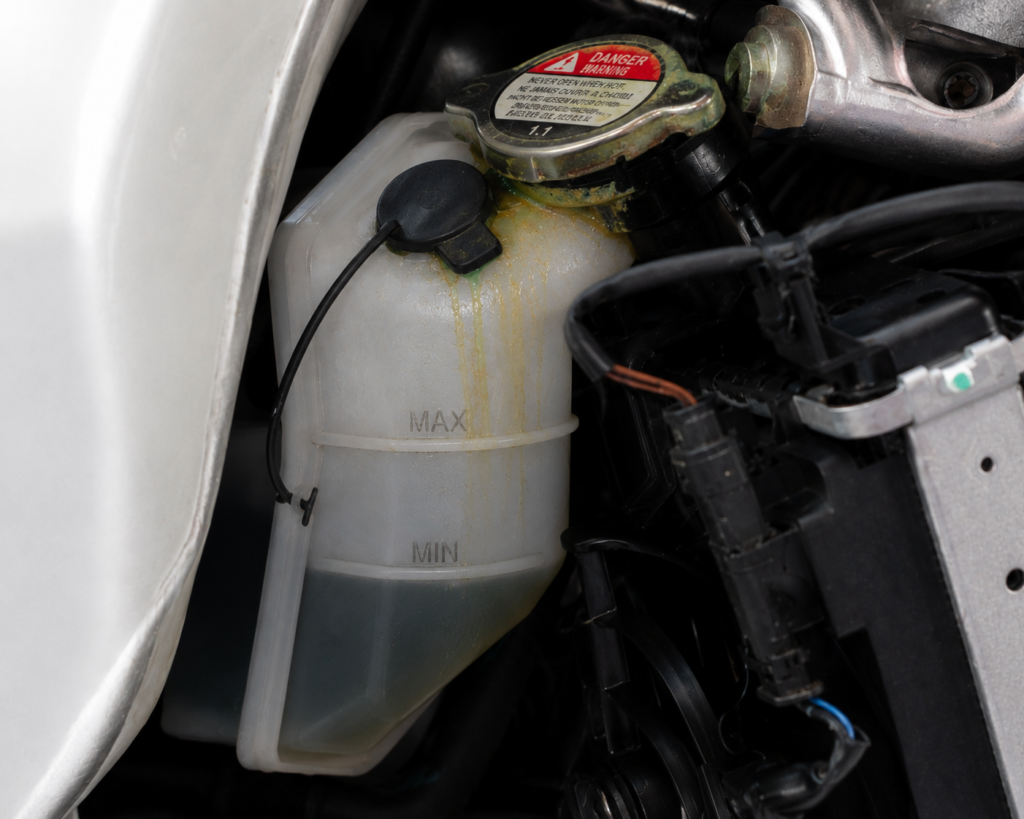
Coolant traces around the radiator cap and an abnormally low level in the expansion tank. These signs should always prompt an inspection of the cooling system before overheating occurs.
The Expansion Tank and Changes in Coolant Level
The coolant level in the expansion tank is another useful indicator, but a single observation provides relatively little information.
What becomes much more useful is the trend.
A slightly different level observed only once can depend on several factors.
However, a gradual decrease observed under comparable conditions over several checks indicates that a real change is taking place and deserves to be understood.
That is precisely the difference between a simple snapshot of the situation and actually monitoring it over time.
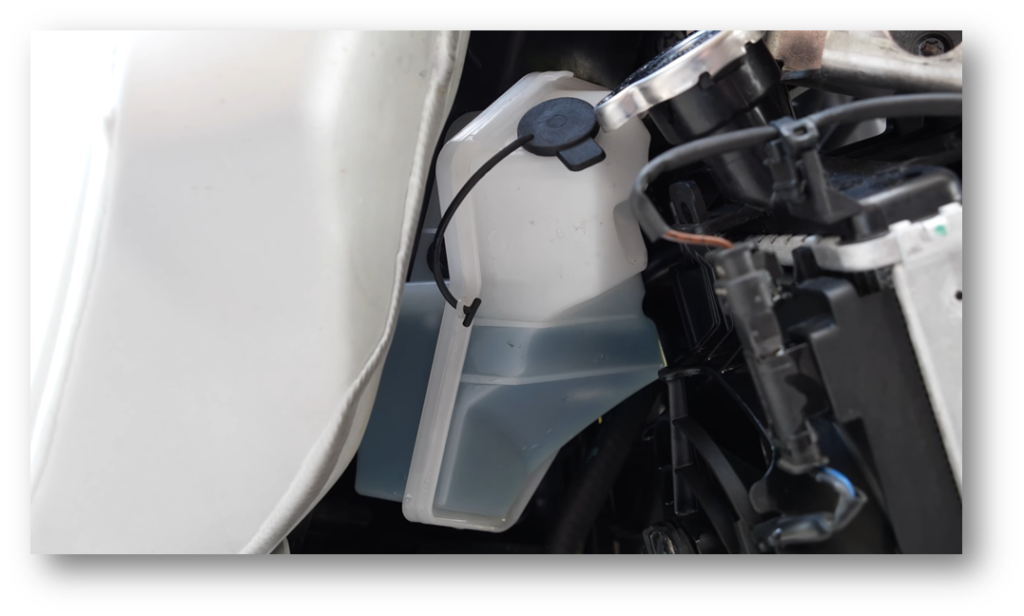
The coolant level in the expansion tank should not be checked just once, but monitored over time. A gradual drop over several weeks is often a better indicator than a visible leak on the ground.
What Matters Is How the Signs Change Over Time
A dried trace, a slight smell, or a change in coolant level is not enough on its own to diagnose a cooling system problem.
But several signs appearing together, or gradually changing over time, tell a different story.
It is often the repetition and progression of these signs, far more than any single isolated clue, that show when a cooling system deserves closer attention.
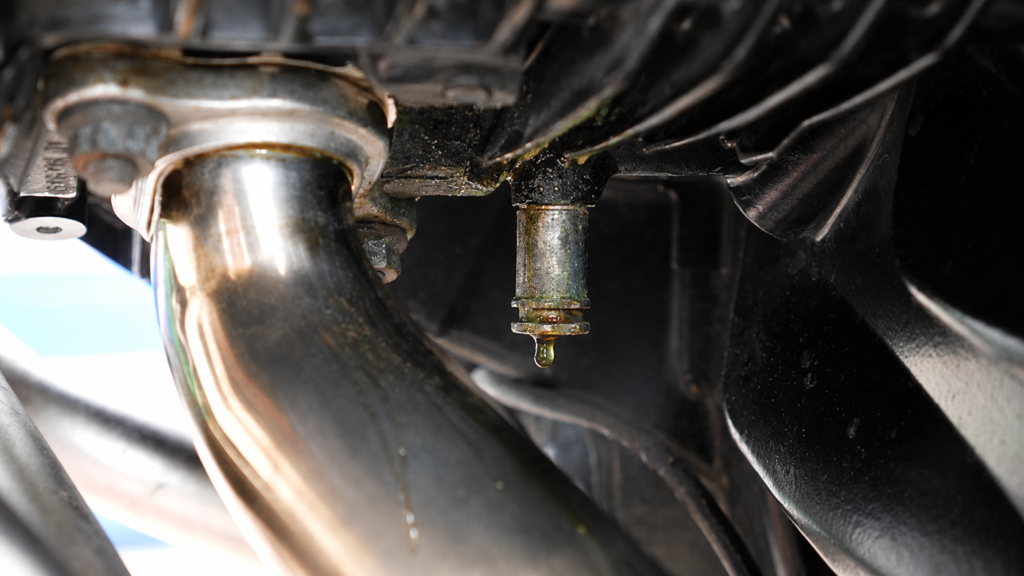
A single coolant droplet can be an early sign of a sealing issue. Regular visual checks can often reveal these signs before they lead to a significant drop in coolant level.
Again, none of these signs proves that there is a failure. They are early warnings telling you “check it now” before it turns into a problem on the side of the road.
What Can Make BMW GS LC Cooling Problems Worse
A cooling system that begins to show signs of weakness does not react the same way under all conditions.
Certain situations increase the thermal load or make a small coolant loss more difficult to detect.
They do not necessarily cause the problem on their own, but they can accelerate its progression or reveal an existing weakness more quickly.
Hot Weather and Slow Riding
When the outside temperature is high, the cooling system is already operating under more demanding conditions.
Slow riding adds another constraint because the natural airflow through the radiators is reduced.
The system must then rely more heavily on coolant circulation and fan operation to dissipate heat.
If coolant loss, a sealing issue, or radiator contamination is already present, these conditions can make the situation more noticeable.
Heat does not necessarily cause the fault, but it can reduce the available margin before the engine’s thermal behavior begins to change.
Off-Road Riding, Mud, and Debris
During off-road riding, mud and debris can partially cover the radiators and reduce airflow.
They can also hide coolant traces, deposits, or small damp areas that would be much easier to spot on a clean motorcycle.
It is this double effect that deserves attention:
mud can both reduce cooling efficiency and make certain warning signs harder to see.
A motorcycle that has been ridden extensively in these conditions can therefore place greater demands on the cooling system without a problem being immediately obvious.
Ignoring a Gradual Drop in Coolant Level
A small drop in coolant level may seem insignificant when the motorcycle continues to operate normally.
That is precisely what can make the situation misleading.
The cooling system may continue to perform its job correctly for some time, even while a small amount of coolant is gradually being lost.
But if that trend continues, the operating margin decreases.
What matters, therefore, is not just the level observed on a given day, but how it changes over time.
A repeated drop in level always deserves to be understood, even if no warning light is on and the motorcycle still seems to be operating normally.
What Helps Preserve the Cooling System Over the Long Term
Cooling system problems rarely become expensive when the very first sign appears.
They become expensive mainly when a subtle sign is ignored long enough for the situation to develop.
The best approach is therefore not to wait for an obvious leak or a temperature warning.
It is to spot small changes before they become significant enough to actually affect the operation of the cooling system.
Do Not Wait Until the Problem Becomes Obvious
A slight smell, a dried trace, or a small change in coolant level may seem too insignificant to deserve attention.
But this is precisely the stage when a potential problem is often easiest to understand.
Once actual overheating occurs, the situation changes completely: it is no longer simply a matter of finding the cause of a small abnormality, but also checking that it has not caused other consequences.
The earlier a cooling system problem is understood, the less chance it has to develop silently.
Monitor a Trend Rather Than a Single Reading
A single observation only shows the condition of the cooling system at one specific moment.
Several observations made under comparable conditions allow you to see whether something is actually changing.
This is particularly true for the coolant level in the expansion tank.
A small difference observed only once is not necessarily significant.
However, a drop that repeats or progresses over time deserves to be understood.
Look for Traces, Not Just Visible Leaks
A leak does not need to form a puddle under the motorcycle to leave clues.
Very slight seepage can dry before the coolant even reaches the ground.
It may then leave:
- a whitish deposit;
- unusual discoloration;
- a slightly marked area around a connection;
- old traces on a hose or engine casing.
These clues can sometimes be the only visible evidence of an intermittent coolant loss.
The absence of a drop on the ground does not necessarily mean that no coolant has been lost.
Coolant Is Also Part of Routine Maintenance
Coolant is not a permanent fluid.
Over time and through repeated heat cycles, its properties can change.
Its condition is therefore part of general cooling system maintenance, just like the condition of the hoses, connections, seals, and heat-exchange surfaces.
A properly maintained cooling system helps limit conditions that promote corrosion, deposits, and premature aging of certain components.
The goal is not to replace coolant at random.
It is simply to consider the cooling system as a complete system that deserves periodic maintenance, rather than something that only requires attention when a problem appears.
What You Need to Remember
With this type of problem, the most important thing is not to wait for a failure.
It is to notice the change:
- a new trace;
- an unusual smell;
- a gradual drop in coolant level;
- a damp area;
- thermal behavior that is different from what you are used to.
Taken individually, these signs do not always allow you to make a diagnosis.
But their appearance, repetition, or progression can show that a cooling system deserves closer attention.
On a BMW GS/GSA LC, a small sign noticed early enough can be far more useful than a temperature warning that appears once the problem has already become obvious.
To Go Further
Understanding why a cooling system can begin to change long before an obvious failure appears is the first step.
But when it comes time to actually inspect the system, drain the coolant, refill it, and bleed it correctly, the method becomes essential.
That is precisely the part I reserve for the guide.
In it, I detail the complete procedure for the BMW R1200 GS/GSA LC and R1250 GS/GSA: inspection points, draining, refilling, bleeding, mistakes to avoid, torque specifications, recommended consumables, and photos.
The goal is to let you carry out the work with a clear method, in the correct order, without improvising, even if you are doing the procedure for the first time.
Related Quick Check:
Related Workshop:
Access the Complete Guide:
https://chrisbach.gumroad.com/l/iagmmp
Join the Facebook Group:
https://www.facebook.com/groups/913934631041780
The Workshop helps you understand why the cooling system deserves attention.
The guide explains how to inspect and service it correctly, step by step.
Back to the Blog:
https://chrisbachworkshop.com/blog/
Electronic Diagnostics Guide with MotoScan:
Complete MotoScan Ultimate Guide for BMW R1200 GS/GSA LC & R1250 GS/GSA