
Does your GS suddenly feel too firm, too soft, more vague, or simply different from usual?
The first reaction is often to suspect the ESA. However, a bad feeling alone is not enough to conclude that there is an electronic failure, and system components can be expensive to replace.
Before going any further, a few simple observations can already help narrow things down.
This Quick Check is based on 4 simple checks to help you determine whether the change seems more likely related to riding conditions, load, a setting, mechanical wear, or whether there are instead objective signs that genuinely justify suspecting the ESA.
The goal is not to diagnose the problem in a few minutes.
The goal is to move from a vague impression to observations you can actually use.
The 4-question filter
1. Does it change with the load?
Compare how the bike behaves in situations you already know:
- solo;
- two-up;
- with luggage;
- lightly or heavily loaded.
If the bad feeling appears mainly as the load increases, don’t immediately conclude that the ESA has failed.
Instead, start by noting this simple fact: the bike’s behavior seems to depend on how it is configured.
That can point toward several possibilities, including preload, load compensation, the condition of the shock, or simply the conditions in which the suspension is working.
Useful check: note whether the problem occurs in every configuration or only in certain ones.
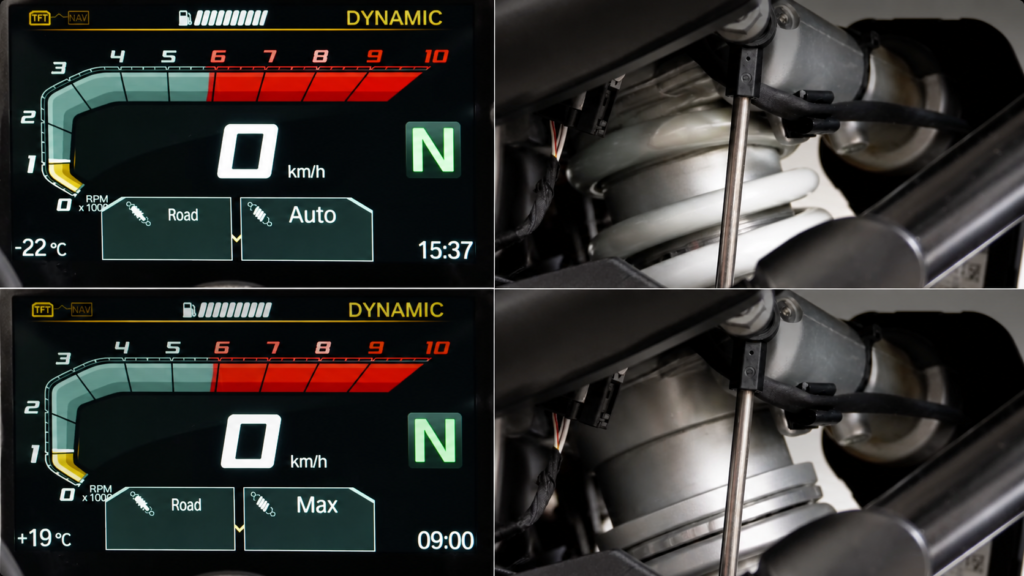
The preload setting changes how the suspension adapts to the load. Comparing Auto and Max makes it easier to see that the system is actively adjusting the suspension setup, without telling you by itself whether the shock is mechanically in good condition.
2. Is it constant, or does it depend on the conditions?
Pay attention to when the issue actually appears:
- right from the start;
- only on certain roads;
- only when the bike is loaded;
- after a long period of riding;
- after the suspension has been working hard;
- completely at random.
An ESA system fault can also be intermittent, so variable behavior alone is not enough to rule it out.
However, if the same feeling keeps coming back under the same circumstances, that repetition becomes useful information.
Useful check: look for a repeatable pattern rather than relying on a simple impression.
3. Do you feel a difference when you change the setting?
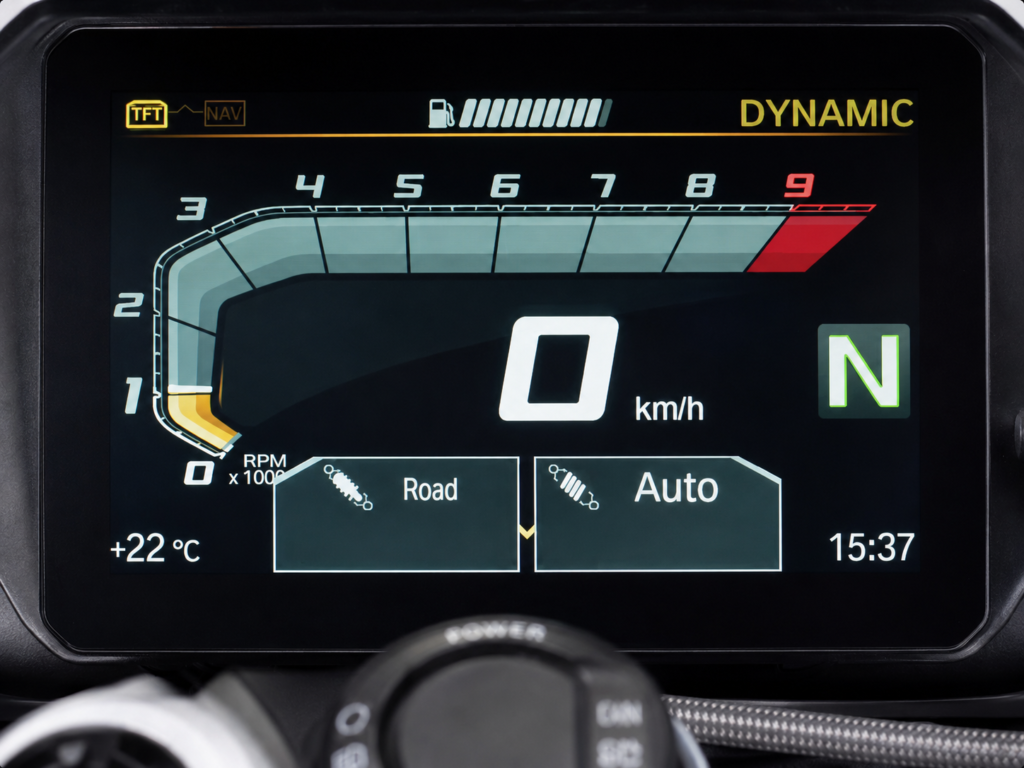
If your bike offers damping settings that are different enough, observe how it behaves on a familiar stretch of road and under comparable conditions.
There’s no need to deliberately look for a big bump.
The goal is simply to see whether changing the setting still produces a noticeable difference.
- If the behavior changes, the system is at least still altering the suspension response.
- If you cannot feel any difference when one should be noticeable, that is a clue worth noting, but it is not yet proof of a failure.
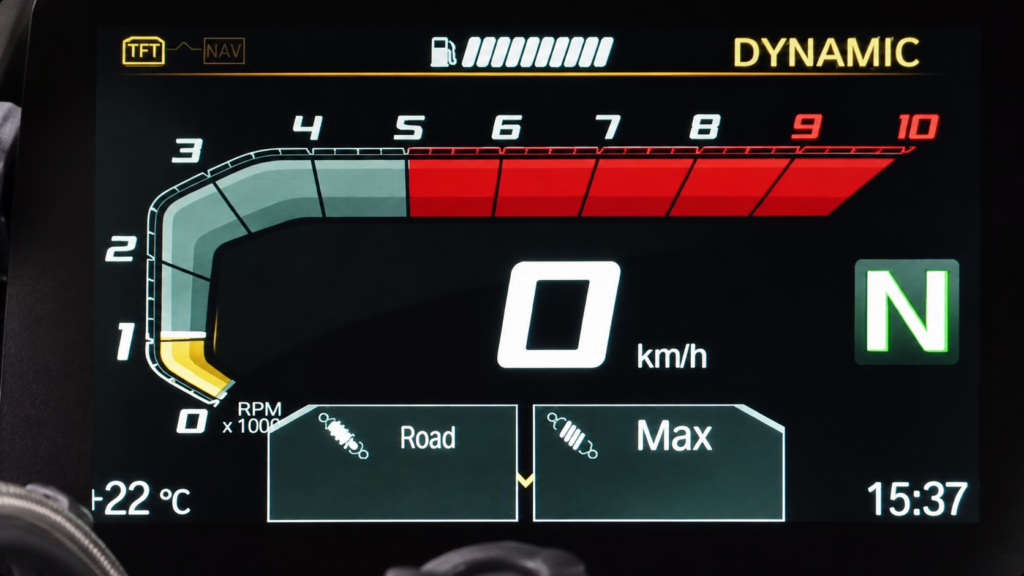
A change in settings should be evaluated under comparable conditions. The absence of a noticeable difference is a useful clue, but by itself it is not proof of an ESA failure.
Useful check: compare the bike under the same conditions so you don’t confuse a change in suspension setting with a change in the road itself.
4. Do you have an objective fact?
This is probably the most important question.
Try to separate what you feel from what you can actually observe.
For example:
- a recurring ESA warning on the dashboard;
- a visible leak from a shock;
- a sudden change in behavior;
- an unusual imbalance between the front and rear;
- a problem that consistently appears under the same conditions.
An ESA warning means that a fault has been detected in the system, but by itself it does not identify the exact cause.
Likewise, a sudden change can have an electronic, electrical, mechanical, or hydraulic cause.
Useful check: before looking for the part to blame, start by gathering facts.
Without an objective sign or a repeatable pattern, you are still dealing mainly with a subjective feeling.
The classic trap
Replacing parts because “it just doesn’t feel right.” A shock can be mechanically worn, with tired seals or degraded oil, and the bike may then feel bouncy or sluggish even though the ESA electronics are working perfectly. The ESA adjusts what is still there; it cannot recreate hydraulic control that has been lost.
Conclusion
Before blaming the ESA, apply this quick filter and always go back to the basics.
Start by checking:
- tire pressure;
- tire wear and profile;
- the load on the bike;
- any visible leak or obvious abnormality;
- how the suspension reacts when you change its settings.
If no warning appears, there is no sudden change in behavior, and the issue varies with load, road surface, or riding conditions, don’t jump too quickly to the conclusion that the ESA has failed.
On the other hand, if changes in settings no longer produce the usual response, a warning keeps coming back, or abnormal behavior becomes clearly repeatable, you then have facts that justify taking the diagnosis further.
The goal of this Quick Check is not to find the fault immediately. It is to determine whether you actually have a reason to suspect the ESA.
A question to ask yourself
If your GS feels normal at the beginning of a ride but starts to deteriorate after the suspension has been working hard, what has actually changed: the electronic system, the shock’s operating conditions, or something else?
That is exactly the kind of observation that helps turn a simple feeling into a useful diagnostic lead.
The complete workshop method
Don’t guess. Diagnose.
I wrote two complementary guides for BMW R1200 GS/GSA LC and R1250 GS/GSA owners who want to understand their motorcycles, maintain them properly, and go further with diagnostics.
The GS/GSA LC Maintenance Guide covers maintenance procedures step by step and includes, among other things, an appendix dedicated to ESA / Dynamic ESA, with the logic and checks needed to distinguish between an incorrect setting, mechanical wear, and a genuine system failure.
The Complete Electronic Diagnostics Guide with MotoScan Ultimate goes even further into electronic fault analysis and diagnostic methodology, helping you learn how to understand what the motorcycle is telling you, check the possible causes, and confirm a diagnosis before replacing a part.
The goal is always the same:
understand, check, then act only once the actual cause has been identified.

Related Workshop article:
Chris Bach Workshop #04 – GS/GSA LC – ESA / Dynamic ESA: Electronic Failure or Worn Shock?
Access the full maintenance guide:
https://chrisbach.gumroad.com/l/iagmmp
Access the Complete Pack:
MotoScan Diagnostics Guide for BMW GS/GSA LC
Join the Facebook group:
https://www.facebook.com/groups/913934631041780
The blog helps you understand.
The guide helps you take action correctly, step by step.
Back to the blog:
https://chrisbachworkshop.com/blog/