
A GS/GSA that starts feeling more vague, firmer, bouncier, or less stable does not automatically mean the ESA system has failed.
Yet that is an easy conclusion to jump to.
The motorcycle is equipped with electronic suspension. Its behavior changes. So the ESA naturally becomes the first suspect.
But the same feeling can have several different causes:
- worn or deformed tires
- incorrect tire pressure
- a different load
- play in a bearing or pivot
- a shock that is starting to wear out
- a mechanical problem
- an actual ESA system failure
On a BMW GS/GSA LC, understanding the difference between the electronic control of the suspension and the mechanical condition of the shock can already prevent a lot of incorrect diagnoses.
ESA and the shock: two things that should not be confused
The ESA changes how the suspension behaves.
It does not restore the mechanical condition of a shock.
On GS/GSA LC models equipped with Dynamic ESA, BMW uses a semi-active suspension system capable of adapting damping to the motorcycle’s movements and riding conditions.
Depending on the generation and equipment fitted to the motorcycle, the system can act on:
- damping
- the different suspension modes
- preload
- and, on some later versions, automatic load compensation
This can noticeably change how the motorcycle feels.
It may feel:
- firmer
- more comfortable
- better controlled
- more stable
- better suited to the load or type of riding
But there is one fundamental limit:
the electronics can only work with a shock that is still mechanically capable of doing its job.
If the shock’s internal hydraulic performance deteriorates with wear, the ESA cannot recreate what has been lost.
The system may still command the available settings and produce a noticeable difference between different modes.
That does not necessarily mean the shock still performs as it did when new.
A functioning ESA system and a shock in good mechanical condition are not exactly the same thing.
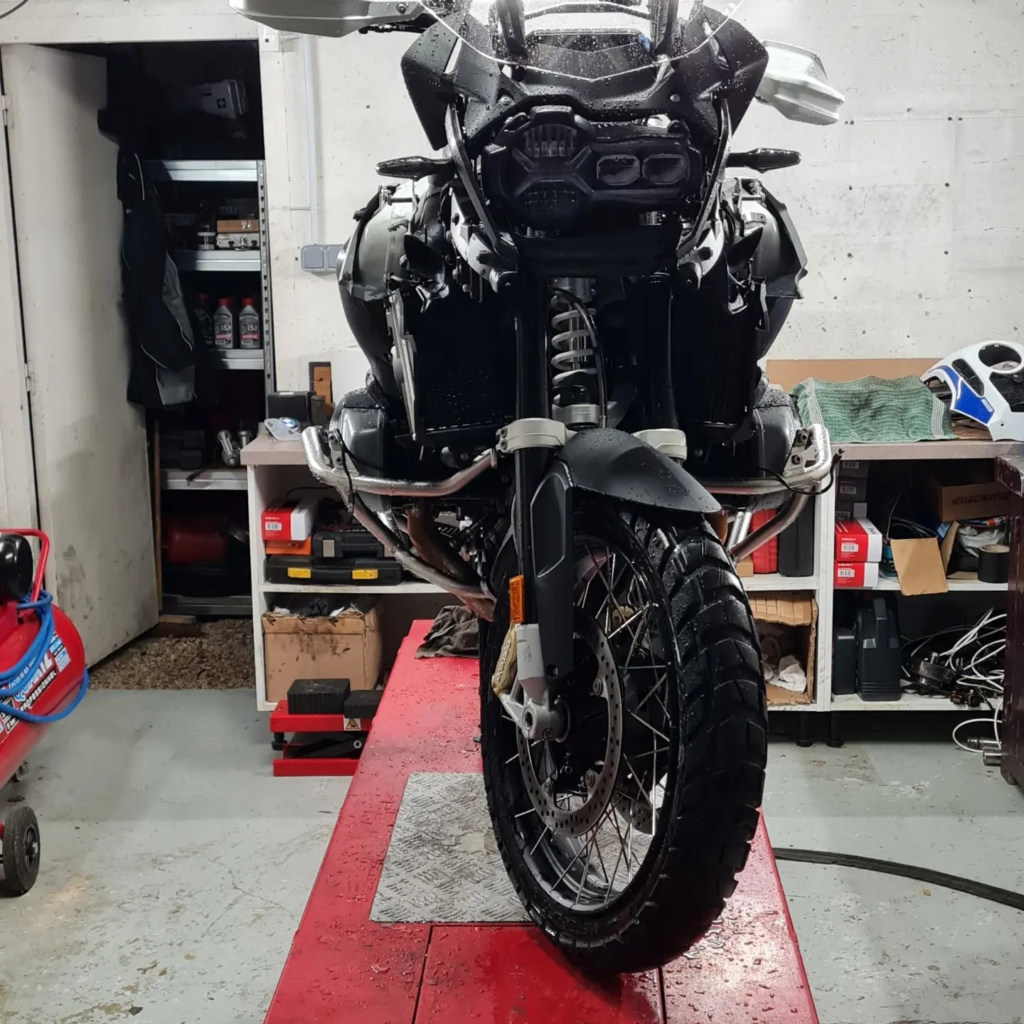
A bad feeling is not a diagnosis
Owners often describe suspension problems using very similar terms:
- “It feels bouncy.”
- “It has become too firm.”
- “The front feels vague.”
- “The rear is pumping.”
- “It feels less stable under braking.”
- “It feels sluggish.”
Those sensations can be completely real.
But none of them, by itself, proves that the ESA system has failed.
The same sensation may come from:
- tire condition or profile
- tire pressure
- load
- preload setting
- temperature
- road surface
- mechanical wear inside the shock
- or an actual ESA system problem
Workshop logic starts with one simple rule:
feeling a change tells you that something is different. It does not yet tell you what caused it.
The three classic traps
Trap 1: confusing a symptom with a failure
A motorcycle that feels bouncier than before gives you useful information:
something has changed.
But that change does not yet identify the cause.
The feeling is therefore a starting clue, not a diagnosis.
Trap 2: replacing a part before isolating the cause
Components related to electronic suspension systems can be expensive.
Replacing something simply because the motorcycle “doesn’t feel like it used to” turns an assumption into a diagnosis.
If the real cause is somewhere else, the motorcycle will still behave badly after the part has been replaced.
Replacing an expensive part unnecessarily does not make the diagnosis any better.
Trap 3: looking for a complicated cause before checking the basics
The ESA naturally attracts attention because it is a sophisticated electronic system.
But the suspension works together with the rest of the motorcycle:
- tires
- wheels
- chassis
- bearings
- pivots and linkages
- the load being carried
If one of those things changes, the overall behavior of the motorcycle can change as well.
Before blaming the electronics, you need to keep the whole motorcycle in mind.
Shock wear or ESA failure: what clues can help?
There is no simple rule that allows you to determine from the seat alone whether the problem comes from the shock or the ESA system.
However, certain clues can help point the diagnosis in the right direction.
A gradual deterioration may point toward wear
As a shock gradually loses performance, several changes may appear:
- more suspension movement
- increased bouncing
- the motorcycle taking longer to settle
- less control over repeated bumps
- less precise behavior when the motorcycle is loaded
The change can happen so gradually that the rider becomes used to it.
Sometimes the extent of the deterioration only becomes obvious when a different situation exposes it:
- a rougher road
- a heavier load
- riding with a passenger
- comparing the motorcycle with another bike
A gradual deterioration is therefore a useful clue pointing toward mechanical wear, but it is never proof by itself.
A sudden change deserves different attention
If the motorcycle’s behavior changes suddenly while the usual conditions remain the same, the situation deserves a different kind of investigation.
Possible causes include:
- a leak
- mechanical damage
- an electrical problem
- an electronic problem
- a sudden mechanical event
A dashboard warning or a setting that no longer reacts as it did before also provides additional information.
However, it would be far too simplistic to reduce the situation to:
“gradual = mechanical”
and
“sudden = electronic.”
The way the problem appears is simply one more clue in the diagnostic process.
What Dynamic ESA Auto mode actually changes
On later generations of Dynamic ESA, BMW added automatic preload management based on load.
In Auto mode, the system can:
- monitor rear suspension compression
- adjust preload
- maintain an appropriate ride height
- adjust damping to riding conditions
This becomes particularly useful when switching:
- from solo riding to riding with a passenger
- from a lightly loaded motorcycle to a touring setup
- from everyday use to traveling with luggage
But this capability can also create confusion.
If the motorcycle maintains the correct ride height, the rider may naturally assume that the entire suspension is still working exactly as it did when new.
That is not necessarily the case.
Correct ride-height compensation does not tell you the hydraulic condition inside the shock.
The system can manage the load and control the damping that is still available.
It cannot mechanically restore a shock whose performance has deteriorated.
Temperature: an often-overlooked factor
A shock converts part of the suspension movement into heat.
As its temperature rises, the behavior of the hydraulic fluid changes as well.
Its viscosity decreases as temperature rises, which can affect damping forces.
On a suspension system in good condition, these variations are normally kept under control.
But when a shock begins to lose efficiency, certain changes may become more noticeable when the suspension is being worked hard.
For example, the motorcycle may feel:
- properly controlled under some conditions
- more vague after a series of bumps
- bouncier after the shock has been working hard
- less stable when repeated suspension movements build up
That does not automatically mean the shock is worn out.
However:
if the same behavior repeatedly appears under similar conditions, it becomes a useful clue to take into account.
What signs can actually point toward the ESA system?
Certain observations give more weight to the possibility of a problem with the control system.
Repeated ESA warnings
A message or warning light related to the system provides objective information that a simple riding sensation does not.
It does not automatically identify the exact cause of the failure.
But it clearly justifies investigating the system itself.
No noticeable response to setting changes
If several settings should produce a noticeable difference and no change can be felt, that deserves investigation.
It is still not proof that a shock or actuator has failed.
But it is a much more useful clue than a general impression that the motorcycle feels too firm or too soft.
Clearly repeatable abnormal behavior
The more consistently a problem can be reproduced under the same conditions, the more useful it becomes for diagnosis.
There is a real difference between:
- “Some days the bike just feels strange.”
- “In this specific situation, the exact same behavior happens every time.”
Workshop logic is about gradually turning the rider’s sensations into verifiable facts.
Before blaming the ESA, go back to the mechanical basics
The sophistication of Dynamic ESA does not change the fundamental rules of motorcycle dynamics.
Tires
Worn, deformed, or cupped tires can cause:
- harshness
- vibration
- imprecise handling
- instability
- changes in steering feel
Tire pressure
Incorrect tire pressure can make the motorcycle feel:
- vague
- sluggish
- less precise
- different between two otherwise similar rides
Bearings, pivots, and linkages
Mechanical play can create unwanted movement that the rider may interpret as a suspension problem.
Load
Load changes:
- ride height
- weight distribution
- how the suspension works
- braking reactions
- acceleration reactions
Even an excellent electronic suspension system cannot eliminate the consequences of weak mechanical fundamentals.
So the right question is not:
“My motorcycle feels bad, so is my ESA faulty?”
But rather:
“My motorcycle feels different. What has actually changed?”
The first question closes the diagnosis too early.
The second allows you to start understanding the problem.
The key idea to remember
Dynamic ESA can adapt suspension behavior to riding conditions and, depending on the version, to the motorcycle’s load.
But it cannot compensate for everything.
It cannot:
- eliminate tire wear
- correct incorrect tire pressure
- remove play from a bearing or pivot
- repair a mechanically worn shock
And conversely, a bad riding feel does not automatically mean the ESA system is faulty.
The right approach is to separate three things:
- what the rider feels
- the mechanical condition of the motorcycle
- the operation of the electronic system
Only by separating those three elements can you avoid replacing expensive parts based on nothing more than an impression.
Don’t guess. Diagnose.
This entire diagnostic logic is explained step by step in my GS/GSA LC Maintenance Guide, including the appendix dedicated to ESA / Dynamic ESA, with checks designed to help distinguish mechanical wear, an incorrect setting, and a genuine system failure.
Going further
If you want to go further and understand how to distinguish a worn shock, an incorrect preload setting, a mechanical problem, or a genuine ESA failure, I have detailed the complete diagnostic method in the guide.
You’ll find the checks to perform, the most common mistakes, the points to verify before replacing expensive parts, and the logic used to isolate the actual cause of the problem.
Related Quick Check:
Access the full Maintenance Guide:
https://chrisbach.gumroad.com/l/iagmmp
Join the Facebook Group:
https://www.facebook.com/groups/913934631041780
The blog helps you understand.
The guide helps you take action correctly, step by step.
Back to the Blog:
https://chrisbachworkshop.com/blog/