
On BMW R1200 LC and R1250 ShiftCam engines, checking valve clearance can seem straightforward: a few values to measure, tolerances to stay within, and apparently very little room for interpretation.
In reality, that is exactly what makes this operation deceptive.
A measurement can look perfectly consistent even though it was taken under the wrong conditions.
And when an incorrect value looks believable, the risk is not just misinterpreting the condition of the engine. It is also trying to correct a clearance that may not have had any problem in the first place.
Both engines therefore require precision, but not for exactly the same reasons.
On the BMW R1200 LC, the valve train layout is relatively conventional, but a reliable measurement still requires the engine and camshafts to be positioned under the correct conditions.
On the BMW R1250 ShiftCam, the ShiftCam system adds another layer of complexity: the intake design and its different cam profiles mean you need to clearly understand what you are measuring before drawing any conclusions.
In both cases, the trap is the same:
believing a number is correct simply because it looks plausible.
Valve clearance is not just an abstract measurement. It directly affects proper valve-train operation, correct valve seating, and the engine’s ability to operate properly as its components expand with heat.
In this article, we are going to understand why this clearance is essential, what happens when it becomes too tight or too loose, why ShiftCam can make an incorrect measurement even more misleading, and which signs may justify taking a closer look.
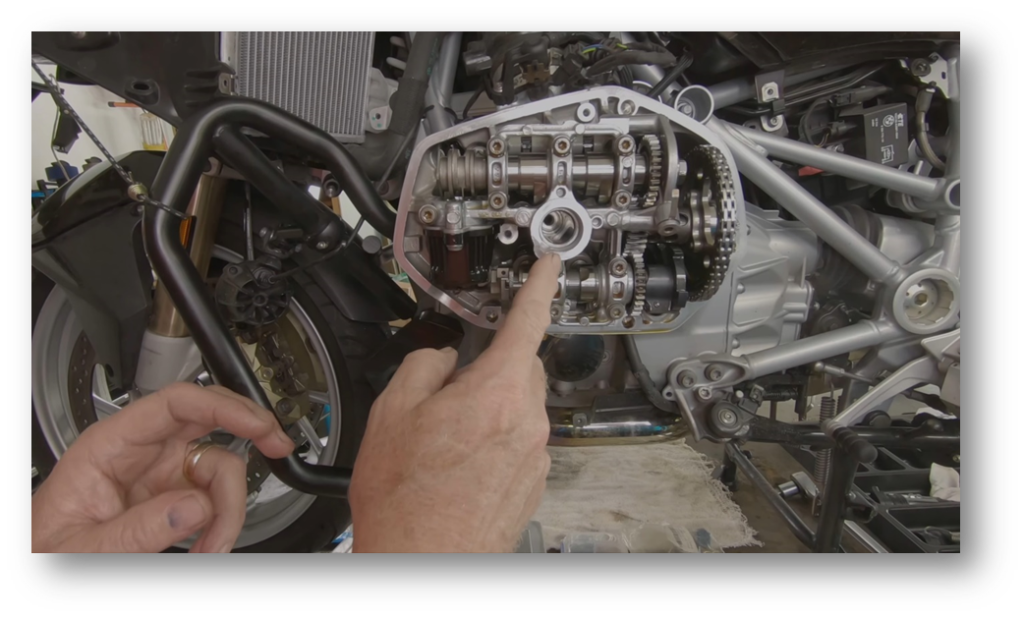
BMW R1250 ShiftCam engine with the cylinder head open. On both the R1200 LC and R1250, checking valve clearance requires precise camshaft positioning. On the R1250, ShiftCam adds another layer of complexity that makes the correct method even more important
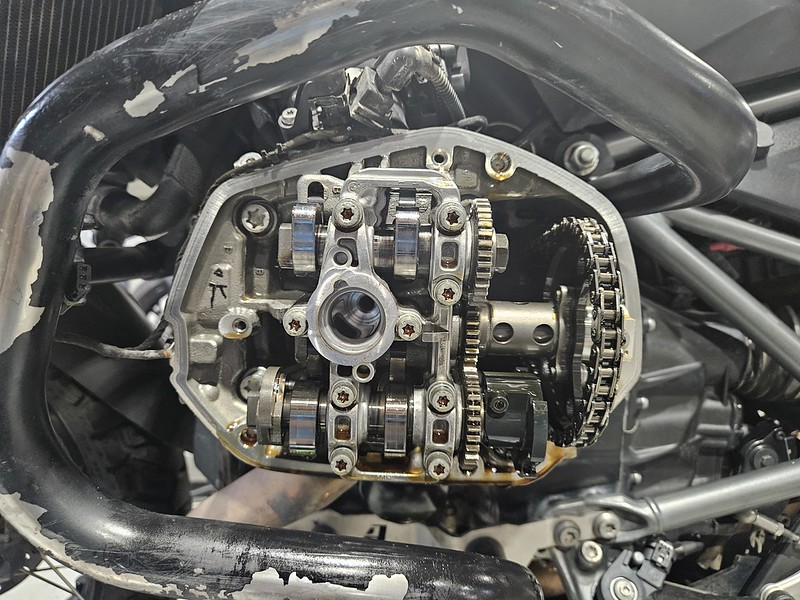
BMW R1200 LC cylinder head. The procedure differs from the R1250 ShiftCam, but the goal remains the same: measuring valve clearance under the correct conditions to obtain a reliable value.
Why Is Valve Clearance Important?
Valve clearance is not just a measurement value.
It exists to allow the various components of the valve train to operate correctly despite temperature changes and the mechanical stresses placed on the engine.
As the engine heats up, components expand. The clearance specified when cold therefore helps maintain the conditions necessary for the valves to continue opening and, above all, closing correctly once the engine reaches operating temperature.
When Valve Clearance Becomes Too Tight
Valve clearance that is too tight is generally the more concerning situation.
If the clearance decreases excessively, a valve may no longer close completely under certain operating conditions.
A valve that closes properly can transfer a significant amount of its heat through contact with its seat.
If that contact becomes insufficient, the valve’s ability to dissipate heat can be compromised.
Over time, this can contribute to:
- loss of sealing;
- reduced compression;
- damage to the valve seat or valve;
- difficult starting;
- progressive deterioration in engine operation.
These consequences are mechanically consistent with insufficient valve clearance, but they do not necessarily appear immediately.
That is exactly what makes excessively tight valve clearance particularly deceptive.
When Valve Clearance Becomes Too Loose
Excessive valve clearance creates a different problem.
The valve still closes properly, but mechanical contact within the valve train becomes more abrupt.
This can lead to:
- increased mechanical noise;
- harder impacts between certain valve-train components;
- increased wear on some contact surfaces;
- changes in valve-train operation.
Excessive valve clearance is therefore generally less critical than insufficient clearance, but that does not mean it is without consequences.
Possible Symptoms Are Not Enough to Make a Diagnosis
Incorrect valve clearance can sometimes be associated with symptoms such as:
- harder starting;
- a less stable idle;
- reduced engine smoothness;
- lower compression;
- certain mechanical noises.
But none of these symptoms is specific to valve clearance.
They can have many other causes.
A symptom may therefore draw your attention, but only a measurement taken under the correct conditions can determine whether valve clearance is actually the cause.
A Rule That Applies to Both the R1200 LC and the R1250
This mechanical principle applies to both engines.
On both the BMW R1200 LC and BMW R1250, valve clearance must remain within the correct range for the valve train to operate normally.
The main difference lies in how easy it is to make a mistake during the check.
On the R1200 LC, the measurement already requires a high level of precision.
On the R1250 ShiftCam, the intake system design adds another layer of complexity that makes misinterpretation even easier if the measurement conditions are not fully understood.
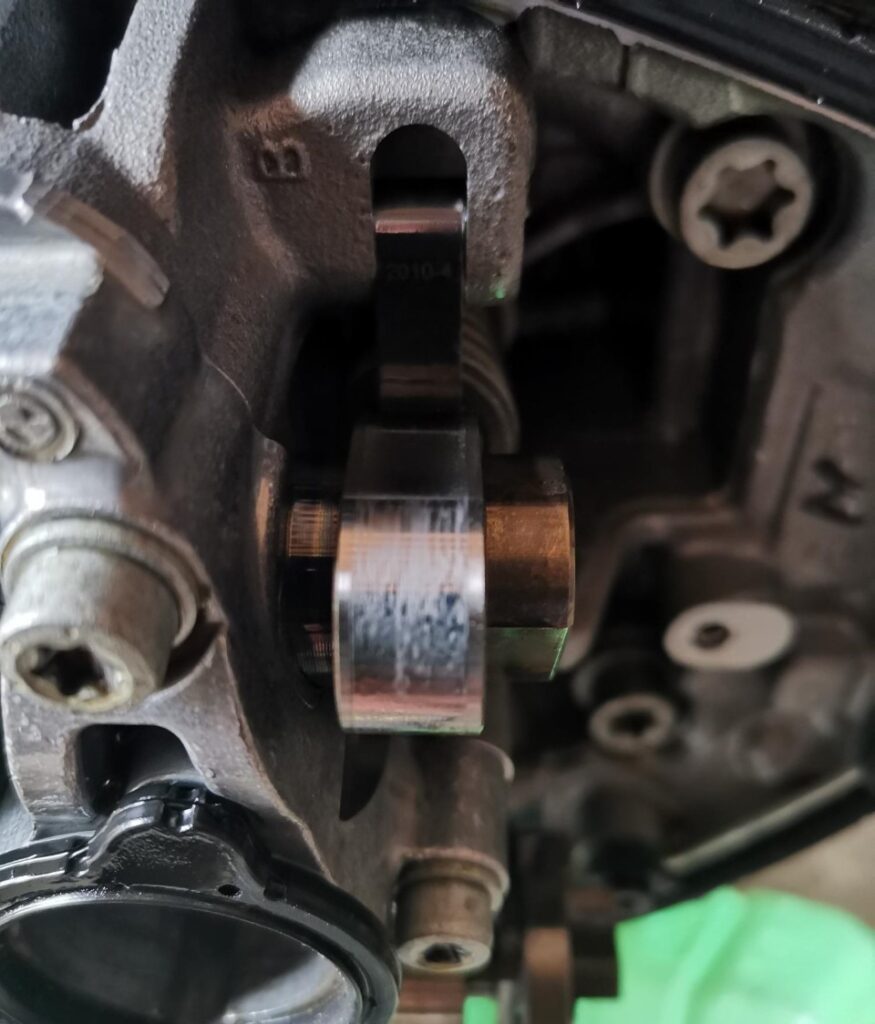
Close-up of the contact between the cam and the valve-actuation mechanism. The measured clearance depends directly on cam position: a value that appears consistent is only meaningful if the measurement conditions are correct.
Why Is the R1250 ShiftCam Trickier Than the R1200 LC?
The main difference is not that the R1250 is impossible to check.
It is mainly that it leaves much less room for approximation.
The BMW R1200 LC already requires a rigorous method and the correct measurement conditions. But its valve train does not use the ShiftCam system, which makes the camshaft logic easier to understand.
On the BMW R1250, ShiftCam adds another particularity on the intake side.
This does not make the check inaccessible, but it does mean that a poor understanding of cam position can produce a value that appears credible even though the measurement conditions are incorrect.
ShiftCam Uses Two Intake Cam Profiles
On the R1250, the ShiftCam system uses two different cam profiles for the intake valves.
Depending on engine operating conditions, the system can move the cam assembly axially to use one profile or the other.
This design allows the engine to adapt intake operation, but it also adds another variable when trying to understand exactly what is being measured.
So it is no longer enough to simply consider the presence of a cam.
You need to understand which part of its profile is acting and why the actual position of the cam is critical to correctly interpreting a measurement.
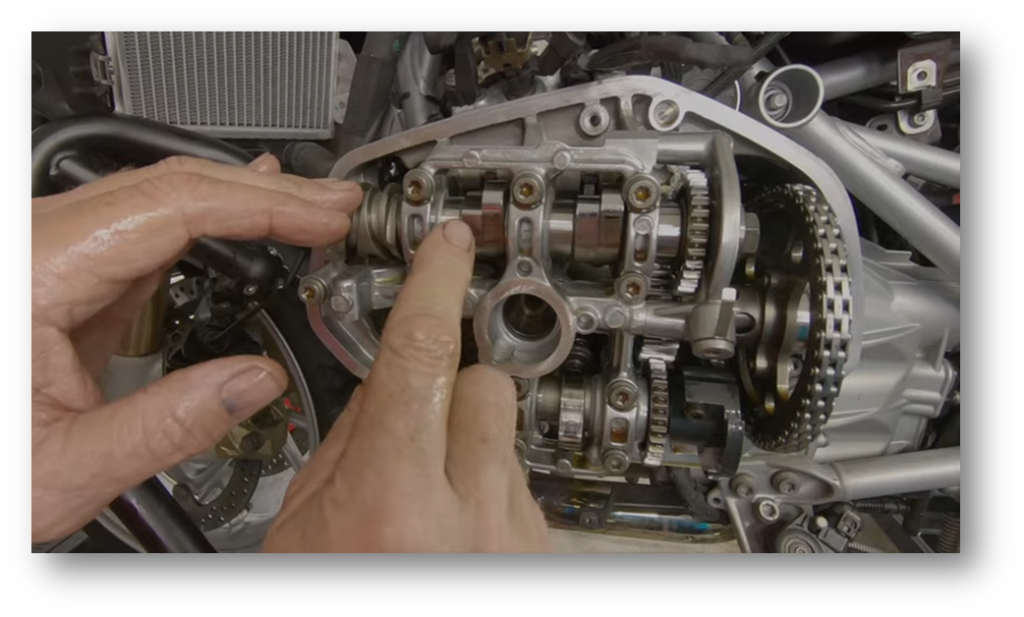
BMW R1250 ShiftCam system. The two intake cam profiles are a distinctive feature of this valve train. When checking valve clearance, measurement reliability depends in particular on the actual position of the cam.
A Poor Cam Position Can Produce a Believable… but Incorrect Value
This is probably the most important trap.
A feeler gauge can slide perfectly between two components and produce a value that appears consistent.
But that does not automatically mean the value actually represents the clearance being checked.
If the cam is not positioned under the conditions required for a correct measurement, a reading can make the clearance appear too tight when the real problem is simply the conditions under which the measurement was taken.
That is precisely what makes this error dangerous: the value obtained can seem plausible enough to inspire confidence.
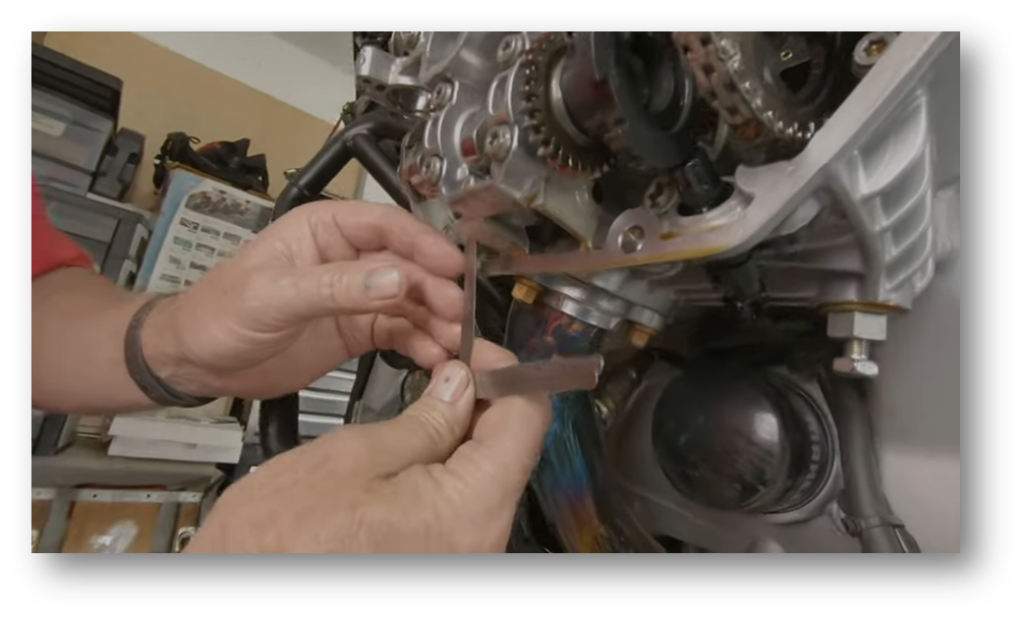
Valve clearance check on a BMW GS LC. A measurement should never be interpreted independently of the conditions under which it was taken: a plausible reading can be misleading if the cam is not correctly positioned.
A Bad Measurement Can Lead to a Bad Correction
This is where a measurement error stops being purely theoretical.
If a value appears to indicate that the clearance is incorrect, the logical reaction may be to correct it.
But if the initial measurement was wrong, the correction that follows may alter a setting that was actually correct.
In other words, an error made at the beginning of the check can then carry through the rest of the reasoning process.
This is particularly important with ShiftCam, where the system’s added complexity can make it seem as though the engine itself has a problem when, in some cases, the measurement logic is what should be questioned first.
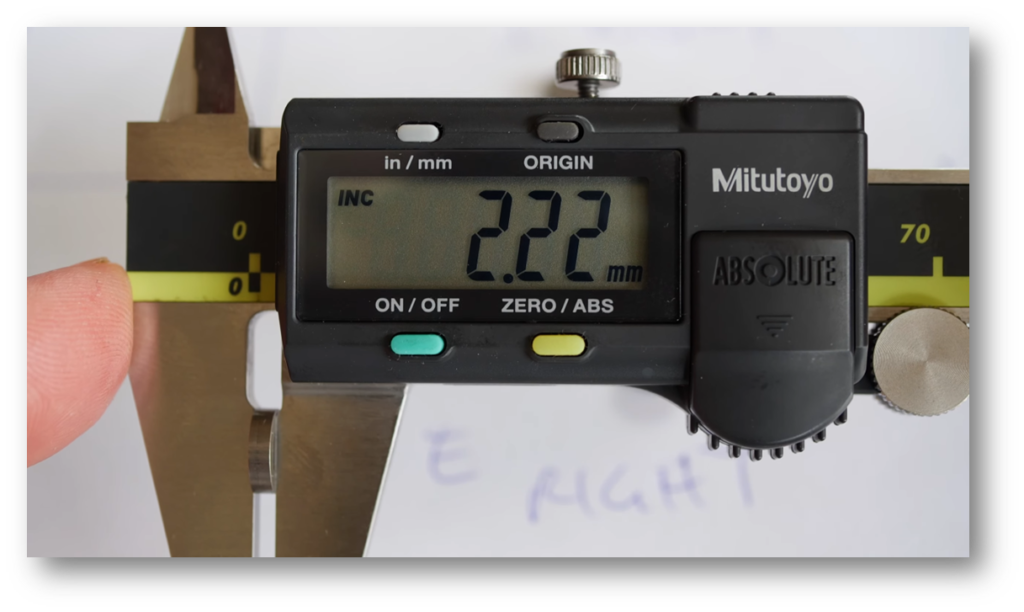
Measuring a valve shim with a digital caliper. This illustrates why an error during the initial valve clearance check can have consequences: if the original clearance is misinterpreted, a perfectly suitable shim may be replaced unnecessarily.
The R1200 LC Also Requires Precision
However, it would be misleading to present the R1200 LC as an engine where an approximate measurement would be acceptable.
It does not have ShiftCam, but the reliability of the check still depends on the correct positioning of the engine and valve train.
The difference is therefore mainly a matter of complexity.
On the R1200 LC, incorrect measurement conditions can already lead to the wrong conclusion.
On the R1250 ShiftCam, the intake system simply adds another layer of complexity that makes this mistake easier to make if you approach it like a more conventional Boxer engine.
What You Need to Understand Before Talking About Adjustment
The key point is simple:
the value you obtain is only meaningful if you can trust the conditions under which it was measured.
That is why checking valve clearance is not simply a matter of sliding in a feeler gauge and reading a number.
What really matters is understanding what that value represents before deciding whether any adjustment is necessary.
What Are the Real Risks of a Bad Measurement?
A measurement error does not necessarily cause an immediately visible problem.
That is exactly what makes it deceptive.
If a value appears credible even though it was obtained under the wrong conditions, two situations can occur: either an actually incorrect clearance goes unnoticed, or a perfectly correct clearance is mistakenly considered to require adjustment.
In both cases, the problem lies less in the number itself than in the confidence placed in a measurement that is not reliable.
Believing Everything Is Correct When the Measurement Is Not
A value that falls within an apparently acceptable range can be reassuring.
But if the measurement conditions were incorrect, that value does not necessarily reflect the actual clearance.
The risk is then to postpone further checking or assume the valve train no longer needs attention simply because the number looked consistent.
A reassuring measurement is only meaningful if you can trust the way it was obtained.
Correcting a Problem That Did Not Exist
The opposite mistake is just as important.
A bad measurement can make the clearance appear too tight or too loose even though the actual adjustment is correct.
From there, it becomes possible to make an unnecessary adjustment.
And that is exactly the kind of mistake that must be avoided: a misinterpretation can create a problem while trying to correct a situation that was actually fine.
Looking Elsewhere Before a Mechanical Cause Has Been Properly Checked
When an engine starts behaving differently, it is easy to immediately focus on the most visible or familiar causes:
- ignition coils;
- spark plugs;
- fuel injection;
- fuel;
- sensors;
- electronics.
Those possibilities can obviously be relevant.
But some symptoms can also have a mechanical cause.
That is why a logical diagnostic process should avoid replacing components at random before properly ruling out mechanical causes that can produce similar symptoms.
Mechanical Deterioration Can Remain Subtle at First
Clearance that has become too tight can gradually interfere with proper valve closing.
If that condition persists, the consequences can progress toward loss of sealing, reduced compression, or thermal damage to the valve and its seat.
The problem is that this progression does not necessarily produce a dramatic symptom right away.
A slow deterioration can therefore look like a sudden failure even though it developed gradually over time.
What Signs Can Justify Checking Valve Clearance?
Certain engine behaviors can draw attention, especially when they appear gradually or represent a change from the motorcycle’s normal behavior.
These can include:
- harder starting, especially when the engine is hot;
- an idle that has become unstable;
- misfires or hesitation under load;
- reduced engine smoothness;
- an unusual change in fuel consumption;
- a new mechanical noise or a noticeable difference between the two cylinders;
- a general feeling that the engine is no longer running quite the way it used to.
None of these symptoms, however, proves that valve clearance is the cause.
Ignition coils, spark plugs, fuel injection, intake, fuel, sensors, or other mechanical causes can produce similar symptoms.
What Matters Most Is the Change
A motorcycle can have certain characteristics for a long time that are perfectly normal.
What deserves more attention is a change from its usual behavior.
Starting that becomes progressively more difficult, an idle that used to be stable and begins to fluctuate, or a new mechanical sensation provides more useful information than a single isolated symptom observed once.
A Symptom Tells You to Investigate, Not What to Replace
This is probably the most important habit to keep in mind.
A symptom is not a diagnosis.
It simply tells you that something deserves to be understood.
Before replacing a part or concluding that an adjustment is required, you need to establish that the suspected cause actually matches what the engine is doing.
This is particularly important with valve clearance, because a poorly performed measurement can itself become a source of misdiagnosis.
The Most Common Reasoning Mistakes
Some mistakes can occur on both the BMW R1200 LC and the R1250.
On the R1250 ShiftCam, the added complexity of the intake system can simply make misinterpretation easier.
All of these mistakes have one thing in common: treating a number as mechanical truth without first confirming that it was actually obtained under reliable conditions.
Placing Too Much Confidence in a Single Measurement
A value can look perfectly plausible and still be misleading.
If the valve train position does not match the conditions required for a reliable measurement, the number obtained may not represent the actual clearance of the valve concerned.
That is precisely what makes this type of mistake dangerous: a bad measurement can look like a good one.
The issue is therefore not simply knowing how to read a feeler gauge.
It is knowing whether the value you just read actually deserves to be interpreted.
Underestimating an Operation Because It Looks Simple
Checking valve clearance uses relatively simple tools.
That can be misleading.
The difficulty does not necessarily come from the tool itself, but from understanding how the valve train works and the conditions under which the value must be interpreted.
On the R1250 ShiftCam, this distinction becomes even more important.
An operation that looks simple can require far more precision than it appears to.
This is exactly the kind of situation where improvisation can produce a value that looks precise… but is mechanically unusable.
Looking at One Value Without Considering the Whole Picture
A measurement should not be interpreted completely independently of the others.
Intake, exhaust, left cylinder, right cylinder: the complete set of values helps provide a better understanding of the overall condition of the valve train.
An unusual value obviously deserves attention.
But the overall consistency of the measurements can provide just as much information as the single number that appears to stand out.
This also helps avoid drawing a conclusion too quickly from one isolated value.
Making an Adjustment Before Being Certain of the Diagnosis
A value that appears incorrect can naturally make you want to act immediately.
But this is exactly when you need to distinguish between measurement, interpretation, and correction.
If the initial interpretation is wrong, any correction that follows is based on a faulty starting point.
That is how an operation intended to solve a problem can end up changing a setting that was already correct.
Considering the Adjustment Finished Without Final Verification
Work on the valve train should not be considered complete simply because a part has been replaced or a value has been changed.
Mechanical logic requires confirming that the result actually matches what was intended.
Without that confirmation, you do not really know whether the intervention corrected the problem, shifted the problem, or created a new inconsistency.
A correction is only meaningful if its result can then be confirmed.
What You Need to Remember
On both the BMW R1200 LC and the R1250 ShiftCam, checking valve clearance is not simply a matter of sliding in a feeler gauge and reading a number.
Measurement accuracy depends first and foremost on the logic being used and the conditions under which the measurement is taken.
This is particularly important on the R1250 ShiftCam, where the intake design adds another layer of complexity that can make an incorrect measurement look very convincing.
The risk is therefore not simply misreading a value.
It is trusting a value that does not actually represent the clearance being checked, then drawing the wrong conclusion or adjusting a setting that was already correct.
That is why a serious valve clearance check should always be approached as a complete process:
measure, understand, interpret, and only then decide whether intervention is necessary.
Going Further
Understanding why a measurement can be misleading is the first step.
But when it comes time to actually perform the check, correctly position the engine, identify the proper measurement conditions, interpret the values, and, if necessary, adjust the clearance, the method becomes essential.
That is exactly the part I reserve for the guide.
In it, I detail the complete procedure for the BMW R1200 LC and R1250 ShiftCam: measurement logic, engine positioning, valve clearance checks, interpretation of the values, shim selection, photos, torque specifications, and mistakes to avoid.
Related Quick Check:
Access the Full Maintenance Guide:
https://chrisbach.gumroad.com/l/iagmmp
Join the Facebook Group:
https://www.facebook.com/groups/913934631041780
The blog helps you understand.
The guide helps you take action correctly, step by step.
Back to the Blog:
https://chrisbachworkshop.com/blog/