
After looking at how the system works, the signs of a sensor reaching the end of its life, and the precautions to take during a tire change, we now arrive at the next stage after a failure: replacing the RDC sensor.
Physically installing a new sensor in the wheel is not always enough.
For the pressure to be displayed again, the motorcycle must be able to identify the new sensor and associate its identification number with the correct wheel.
Why Isn’t a New Sensor Always Recognized Automatically?
Each RDC sensor has a unique electronic identifier.
This identifier allows the motorcycle to know:
- Which sensor is transmitting information.
- Which wheel it belongs to.
- Which pressure should be displayed for the front or rear wheel.
When the original sensor is replaced, its identifier changes.
Depending on the sensor installed and the method used, the motorcycle may sometimes recognize the new sensor after riding, but this is not always the case.
In some situations, the new identifier must be registered in the motorcycle’s RDC system using a diagnostic tool.
What Information Should You Know Before Installation?
Before installing a new sensor, it is important to record its identification number.
This information may be provided:
- On a label attached to the sensor.
- Printed or engraved on the sensor housing.
- On the packaging.
- On a separate label supplied with the sensor.
- In the manufacturer’s documentation.
- Through electronic reading with a compatible tool.
Be careful not to confuse:
- The sensor’s part number.
- The serial number.
- The RDC electronic identifier that must be registered in the motorcycle.
Depending on the manufacturer and the tool used, this identifier may be displayed in decimal or hexadecimal format.
This identifier should be recorded before the sensor is sealed inside the tire.
Once the tire has been mounted, it becomes much more difficult to visually verify the information printed on the sensor.
It is therefore advisable to:
- Photograph the sensor and all markings on its housing.
- Note whether it is intended for the front or rear wheel.
- Keep the packaging until the system has been fully validated.
- Record the installation date.
How Can You Recover the Identifier If You Don’t Have It?
If the label has been lost or the sensor is already installed inside the wheel, several options are available.
Reading the Identifier Stored in the Motorcycle
If the sensor is already associated with the RDC system, a compatible diagnostic tool may allow you to view the identifiers stored for the front and rear wheels.
This method is particularly useful before replacing an old sensor or preparing to clone its identifier.
Reading the Sensor Directly
A compatible TPMS activation or reading tool can wake up the sensor and retrieve the identifier it is transmitting.
This operation can be performed:
- By a tire shop or TPMS specialist.
- With a professional TPMS programming and reading tool.
- With a compatible learning function capable of detecting the sensor while it is transmitting.
Using a Learning Function
Some tools can place the RDC system into learning mode and then retrieve the identifier once the sensor has been activated.
It is therefore not always necessary to immediately remove the tire simply because the sensor label or packaging has been lost.
However, if the sensor has completely failed, its identifier is no longer readable, and it is no longer stored in the motorcycle, recovery may become impossible.
In that case, the new sensor will need to be registered using its own identifier.
What Tools Can Register an RDC Sensor?
Registering a new identifier can be performed with a diagnostic tool that supports the RDC functions of the BMW in question.
Among the solutions commonly used by GS/GSA LC owners are:
- The GS-911.
- MotoScan Ultimate used with a compatible OBD adapter such as the OBDLink LX.
- The BMW diagnostic equipment used by dealerships and specialized workshops.
Depending on the motorcycle model and software version, these tools may allow you to:
- Read existing identifiers.
- Delete or replace the identifier of an old sensor.
- Register a new identifier.
- Assign the sensor to the correct front or rear wheel.
- Verify communication with the RDC system.
The exact functions available depend on the motorcycle, model year, tool, and software version being used.
Manual Registration or Automatic Learning?
Two main methods may be encountered.
1 – Manual Identifier Registration
The identifier printed on the sensor is entered directly into the system using the diagnostic tool.
This method offers a major advantage:
The motorcycle immediately knows which sensor belongs to each wheel.
It also avoids random searches when multiple motorcycles or sensors are nearby.
2 – Sensor Detection or Learning
Some tools and systems can detect the sensor while it is transmitting.
This may require:
- Activating the sensor with a compatible trigger tool.
- Rotating the wheel.
- Riding the motorcycle.
- Launching a learning function through the diagnostic tool.
The exact procedure depends on the equipment being used.
You should not assume that simply riding the motorcycle will be sufficient in every situation.
Why Is Front and Rear Wheel Position Important?
The motorcycle must know which identifier belongs to which wheel.
If the identifiers are reversed:
- The front pressure may be displayed as the rear pressure.
- The rear pressure may be displayed as the front pressure.
- Diagnosing a leak or pressure loss can become misleading.
After registration, it is therefore important to verify that each displayed value corresponds to the correct wheel.
One simple method is to slightly adjust the pressure in only one wheel and then observe which value changes after the display updates.
BMW Sensor or Compatible Sensor?
Two main options are available when replacing a sensor.
The Original BMW Sensor
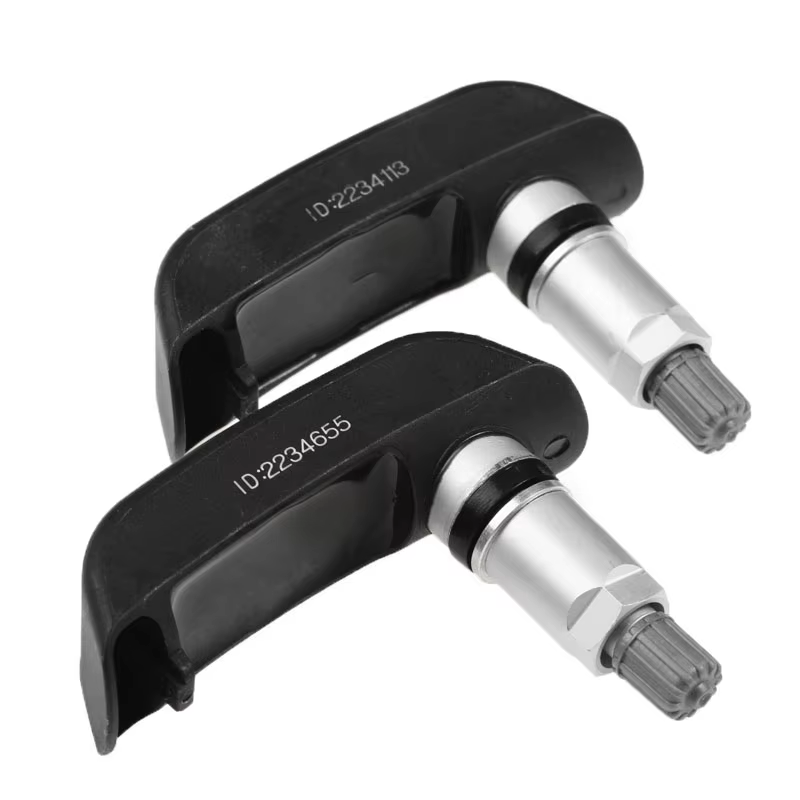
Its main advantages are:
- Compatibility intended for the specific motorcycle model.
- The correct frequency and protocol for the BMW RDC system.
- Simpler identification within the BMW network.
Its main disadvantage is usually the price.
The Compatible Sensor
Many aftermarket sensors are sold as compatible with various BMW GS/GSA models.
They can be less expensive, but several points should be verified before purchasing:
- The radio frequency used.
- Compatibility with the motorcycle’s year and market.
- The valve and mounting design.
- The presence of a usable identifier.
- The ability to program or clone the sensor.
- The actual quality of the product.
A sensor that physically fits the wheel is not necessarily electronically compatible with the motorcycle.
Price alone should therefore never be the deciding factor.
Where Can You Buy Sensors?
Several options are available:
- BMW dealerships and parts departments.
- BMW parts specialists.
- TPMS specialists.
- Aftermarket manufacturers offering recognized compatible sensors.
- Major online marketplaces.
Many owners also purchase sensors from AliExpress.
Some install them and use them for years without experiencing any problems.
However, there is always some uncertainty regarding:
- The actual quality of the sensor.
- Its electronic compatibility.
- Battery life.
- Seal reliability.
- The presence of a readable and usable identifier.
- The ability to program it correctly.
Buying a very inexpensive sensor from this type of platform is therefore something of a gamble. It may work perfectly, but the outcome is generally less predictable than with a BMW sensor or a recognized brand.
Before ordering, you should at least verify:
- The motorcycle model and year.
- The intended market.
- The stated radio frequency.
- The valve and mounting design.
- The presence of an identifier.
- Whether programming is required before installation.
- Reviews relating to the exact same part number.
- The return policy in case of incompatibility.
A sensor that looks identical to the original part may still remain invisible to the motorcycle.
What Is a Cloned Sensor?
Some compatible sensors can be programmed with the same identifier as the original sensor.
This is known as identifier cloning.
The benefit is simple:
If the new sensor uses exactly the same identifier as the old one, the motorcycle may continue to recognize it as though it were the original sensor.
This can eliminate the need to modify the identifiers stored in the motorcycle.
However, this method requires:
- A compatible programmable sensor.
- Knowledge of the original sensor’s identifier.
- A tool capable of programming the new sensor correctly.
Cloning should not be confused with simply copying a number printed on the sensor housing.
Should You Replace the Entire Sensor or Just the Battery?
The official solution is generally to replace the complete sensor when its internal battery reaches the end of its life.
However, some specialists and experienced DIYers choose to open the sensor and replace only the battery.
Complete Sensor Replacement
Advantages:
• Simple and durable solution.
• New housing, electronics, valve, and battery depending on the product selected.
• Less risk associated with opening and resealing the sensor.
Disadvantages:
• Higher cost.
• Registration or programming may be required.
Battery Replacement Only
Advantages:
• Potentially lower cost.
• Ability to retain the original sensor identifier.
• May eliminate the need to modify the registration in the motorcycle.
Disadvantages:
• The sensor must be opened.
• The original resin or seal must be removed.
• The battery must be connected correctly.
• The housing must be resealed and made watertight.
• Final reliability depends heavily on the quality of the repair.
This is not a procedure intended by BMW and requires genuine expertise.
A poorly executed repair can result in early failure, poor sealing, or permanent damage to the sensor.
The photos below show an original RDC sensor after the sealing material has been removed, followed by the installation of a replacement battery.
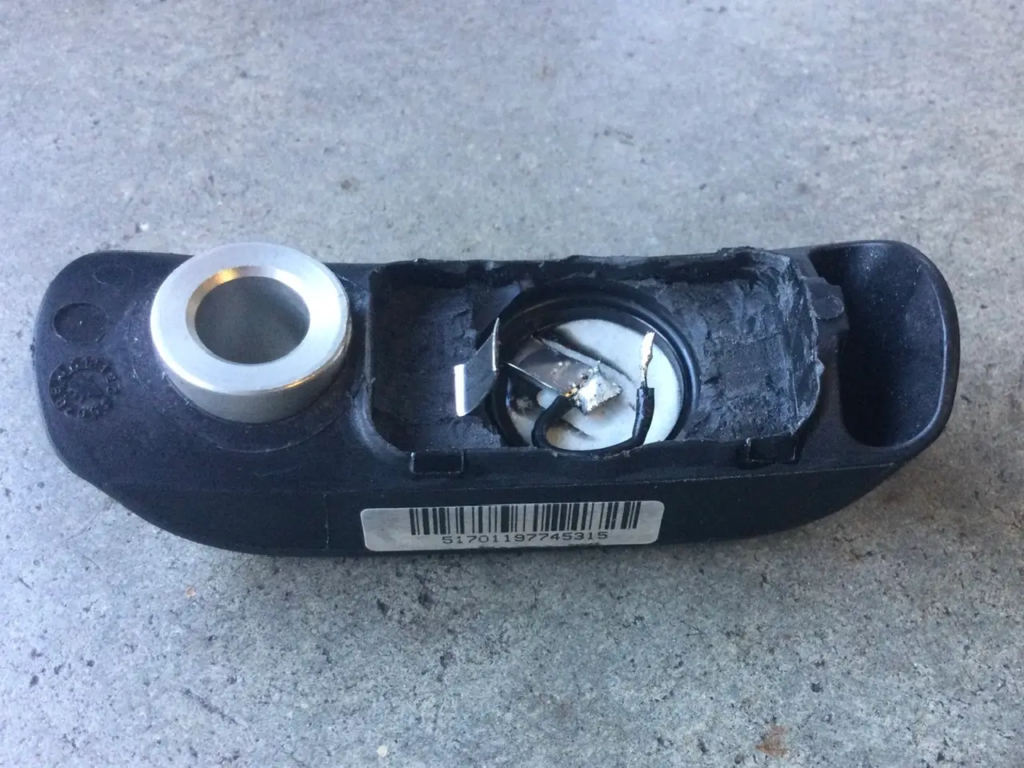
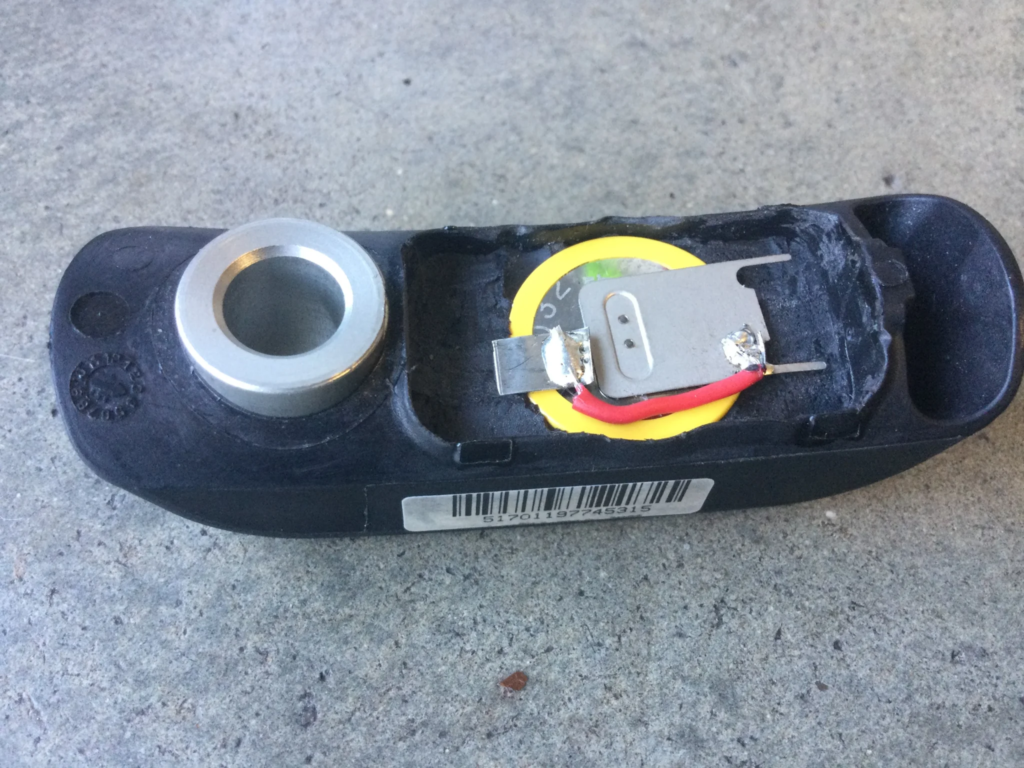
The original battery is connected to the electronic circuit by metal tabs. You should not attempt to solder directly onto a standard CR2032 battery because the heat transferred by the soldering iron can damage it and create a serious risk. A CR2032 battery equipped with solder tabs or pins designed for soldering must be used.
Before ordering, it is nevertheless essential to verify the exact battery reference, dimensions, and terminal configuration inside the sensor concerned.
Original RDC sensors are completely sealed in resin to protect the electronics against moisture, vibration, and the stresses experienced inside the wheel. To access the battery, this resin must be removed very carefully without damaging the components or electrical connections.
After replacement, the sensor must be carefully resealed using epoxy resin or another suitable sealing material. This step is essential to secure the battery, protect the soldered connections, and restore the sensor’s resistance to moisture and vibration.
Replacing the battery allows the original sensor identifier to be retained and may avoid the need to register a new sensor in the motorcycle. However, the final reliability depends entirely on the precision of the work performed and the quality of the new seal.
This repair is therefore intended for people experienced in micro-soldering and electronics. For most owners, replacing the complete sensor during a tire change remains the simplest and most predictable solution.
What Should Be Checked After Replacement?
Once the sensor has been installed and registered, verify:
- That pressure values appear after riding begins.
- That each wheel is associated with the correct value.
- That the display remains stable during the ride.
- That no RDC warning remains active.
- That no leak is present around the valve.
- That any stored faults have been checked and, if necessary, cleared.
It is also useful to keep a record of:
- The sensor part number.
- Its identifier.
- Its installation date.
- Its front or rear position.
- Its origin and brand.
This information can simplify future diagnostics.
Key Takeaway
Replacing an RDC sensor involves more than simply installing a new component inside the wheel.
You must also:
- Choose a truly compatible sensor.
- Record its identifier before installation.
- Know how to recover that identifier if it is no longer available.
- Assign it to the correct wheel.
- Register or program it if necessary.
- Verify proper operation after installation.
A sensor can be brand new, properly installed, and fully functional, yet remain invisible on the dashboard until the motorcycle recognizes its identifier.
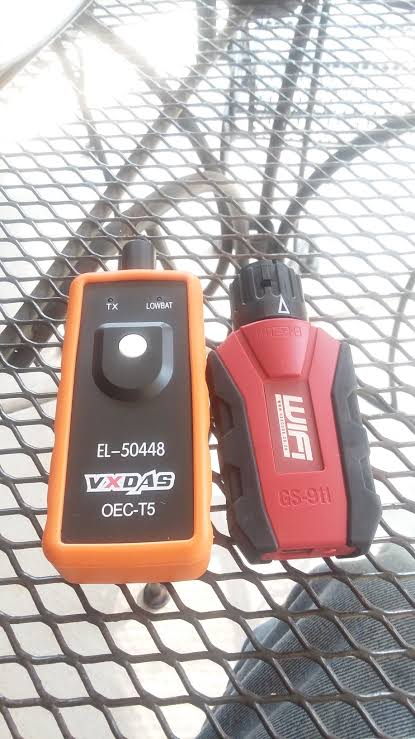
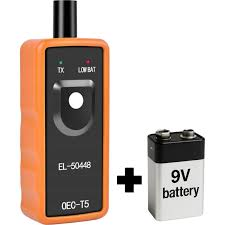
Note: Waking up aftermarket/AliExpress sensors: Some low-cost generic sensors may be shipped in a deep sleep mode to preserve battery life before installation. In some cases, simply riding the motorcycle may not be enough to activate them for the initial learning procedure. A compatible TPMS trigger tool may then be required to wake up the sensor so that the motorcycle’s RDC system can detect its transmitted identifier during the MotoScan or GS-911 learning process. The inexpensive EL-50448 is commonly used successfully with some BMW-compatible sensors, but compatibility is not guaranteed with every sensor type or RDC generation
Related workshop article:
Chris Bach Workshop – GS/GSA LC – RDC 1: Understanding the Tire Pressure Monitoring System (TPMS)
Chris Bach Workshop – GS/GSA LC – RDC 2: How Do You Know When a Sensor Is Starting to Fail?
Chris Bach Workshop – GS/GSA LC – RDC 3: Tire Changes, the Mistakes That Can Damage Your Sensors
Access the full maintenance guide:
https://chrisbach.gumroad.com/l/iagmmp
Join the Facebook group:
https://www.facebook.com/groups/913934631041780
The blog helps you understand.
The guide helps you take action correctly, step by step.
Back to the blog:
https://chrisbachworkshop.com/blog/